Mosh Unveils the IBO, an Initial Bundle Offering for Tokens That Cannot Be Rugged
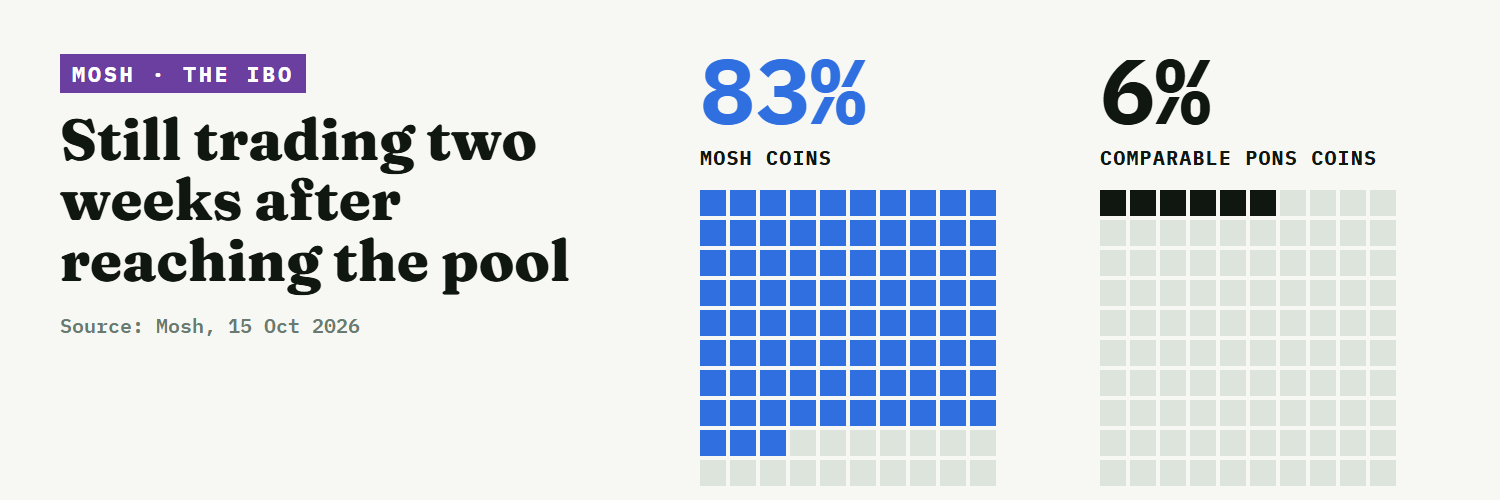
The launch system behind Bundle Cat will let teams sell a share of a token's opening bundle before it launches, with the supply locked and the buyers paid in fees. A tradable launch curve and a curator program for VCs and incubators come in the same release. On Mosh's own figures, 83 percent of its coins are still trading two weeks after reaching the pool, against 6 percent of comparable Pons coins.
Mosh, the token launch system built by UV Labs on Robinhood Chain, will let teams sell a stake in a token's opening bundle to the public before the token exists. The firm calls it an Initial Bundle Offering, or IBO, and its chief executive Justin Bebis described it on X on Thursday as "a new, modern form of ICO for unruggable tokens." It ships in Mosh's next release, alongside a tradable launch curve for bundles and a curator program for VCs, incubators and agencies.
A bundle is the block of tokens bought in the launch transaction, ahead of everyone else. On most launchpads it belongs to the deployer and is the first thing sold. Mosh keeps the bundle and removes the exit: the supply is locked in vaults, AI agents trade it as market makers under fixed limits, and the people who paid for it are paid in trading fees instead of selling into the market. Bundle Cat (BUN), launched on 2 September, was the first token built this way.
The problem, in Mosh's numbers
Bebis opened with the economics of the launchpads Mosh sits on top of. Citing data compiled by the analyst @bandosei, he wrote that the top 25 deployers on pump.fun have taken $128 million in profit, about $5.1 million each, or $168 a launch. Of 761,000 tokens launched, wash-traded and rugged in the sample, 0.96 percent reached a $69,000 market cap, and 1 percent of traders and deployers took 65 percent of the proceeds.
On Robinhood Chain the pattern is the same, according to Mosh: 95.7 percent of tokens that graduated to a Pons pool trade below what their curve buyers paid. On BUN, where the bundle is 71 percent of the supply, 0.3 percent of all selling has come from the bundle.
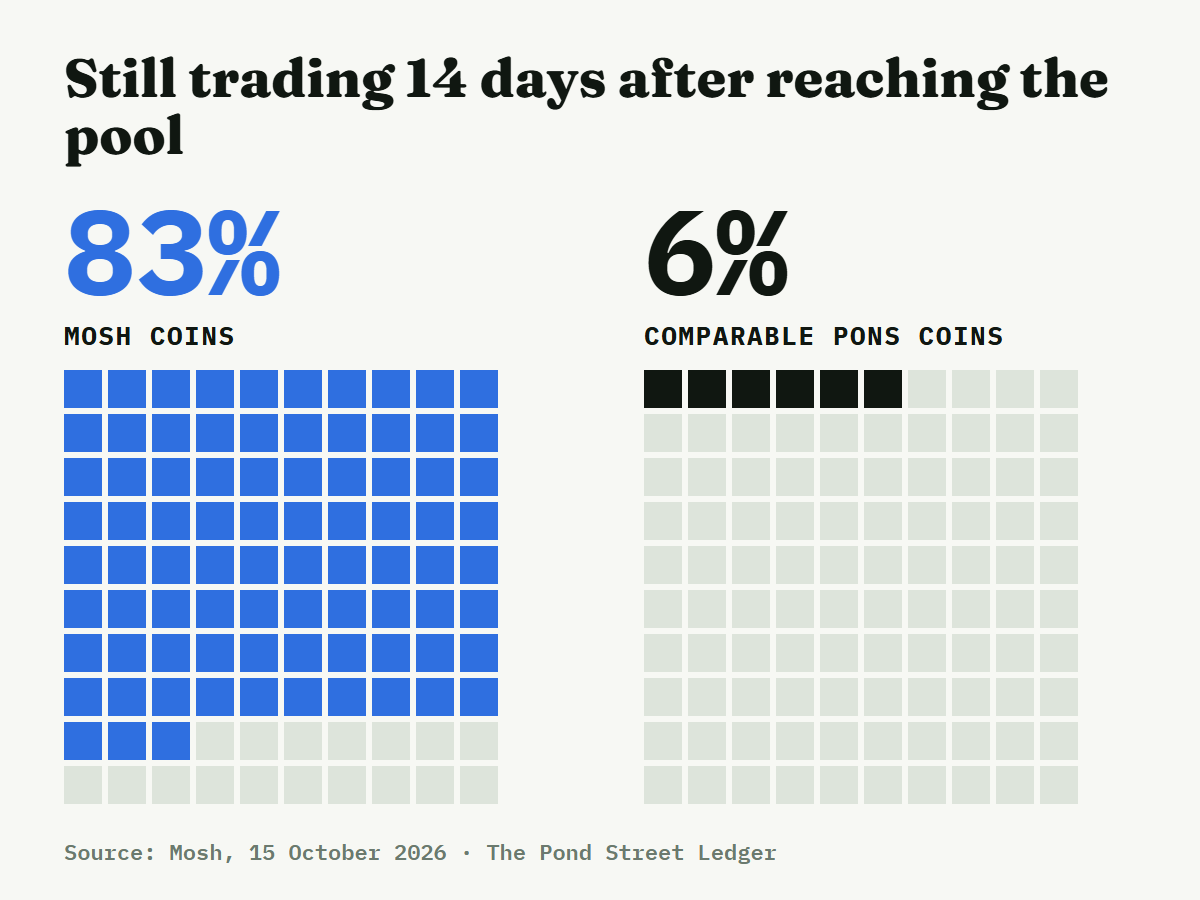
The figure Mosh leads with is survival. Of Mosh coins that reached the pool, 83 percent were still trading 14 days later. For comparable Pons coins the figure is 6 percent.
How an IBO works
An IBO runs in four steps. The team designs the bundle, setting its size and who may join, in staged whitelists. Contributors fund it, for a share of fees or for early supply. The bundle buys its block of supply inside the launch transaction. From then on that supply stays locked or vested and its fees go to the contributors.
The pitch is early exposure without the usual fight. Contributors get in at launch "without needing to fight a sea of scammers, snipers, and frauds," Bebis wrote, and traders who buy afterwards are not buying beneath an overhang, because nothing bought in the bundle can be sold into them. Mosh says it is also shipping block purchases at launch, holder fee sharing and other tools for teams running an IBO.
Launch curves
For launches without a team running a raise, Mosh is adding a mode that looks like the bonding curves on Pump Fun and Pons, except that what is traded is a share of the bundle. Each purchase makes the next one more expensive, and anyone can buy or sell at the curve price at any time before the bundle fills. Fees from that trading are held in a pot. A seller who leaves early leaves their share of it behind. When the last share is bought, the token launches and the pot is paid to the holders in one go.
In the example Mosh published, a share bought first costs 1.00x and the last one 2.25x, buying costs 0.5 percent and selling 5 percent, and the book fills at 8.5 ETH. Bebis called that curve "on the shallower side" and asked for feedback. He expects launch curves to be "more degenerate" than IBOs, and said they let Mosh launch bigger bundles more often while letting contributors sell their stake at any time.
Curators
The third piece is people. Curators can be VCs, incubators or agencies that back teams with capital, go-to-market help or services, and that underwrite deals for the Mosh community to fund. Each gets a configurable cut of fees on the bundles it brings, a place at the top of the IBO page, and a public record of its bundles' results so teams and investors can compare them. Mosh says it will vet each curator's background and expects specialists in DeFi, creators and influencers, AI and robotics, and NFTs.
The record so far
On 7 October, with Mosh live for less than 40 days, its dashboard showed $62.2 million of launchpad volume, $9.1 million of it in the previous week, and $448,000 in revenue, of which $350,900 went to backers and $97,100 to Mosh. Fifty-one agents were running, up from 42 a week earlier. Assets under the agents fell to $41.7 million from $67.5 million over the same week, and the fully diluted value of everything launched to $59.2 million from $96.6 million.
| Measure | 7 October | Over the week |
|---|---|---|
| Launchpad volume | $62.2m | +$9.1m |
| Revenue | $448.0k | +$58.2k |
| Revenue to backers / Mosh | $350.9k / $97.1k | |
| Agents running | 51 | +9 |
| Assets under agents | $41.7m | −$25.8m |
| FDV launched | $59.2m | −$37.4m |
BUN is the proof Mosh points to. Its 8 ETH raise has generated 104.7 ETH of fees, 13 times the raise. The agents have sold 92.4 ETH of BUN and bought back 15.6 ETH on dips, a profit of 76.7 ETH, and Bebis wrote that every dollar the agents make is used to bid the tokens they manage. BUN traded at about $0.053 on Friday morning, DexScreener shows, up 12 percent on the day and close to its 10 September high, for an $11 million market cap and a $53 million fully diluted value.
BUN as equity
Bebis also set out a second role for BUN: as a stand-in for UV Labs itself, convertible one to one into the firm's equity. Mosh labels that conversion "planned, not live", and Bebis said UV Labs is working on standardising the legal process for making Mosh tokens convertible to equity. The quarter's other goals are a funnel of startups and investors, more deal flow through VCs and incubators, and capital from the firm's agentic liquid funds deployed to raise the floor under Mosh tokens. UV Labs is accumulating BUN to fund larger BUN-paired bundles.
Mosh will stay on Robinhood Chain for now. Bebis wrote that the chain "has the biggest upside in crypto right now" and that expanding to other chains or building its own launchpad too early would cost focus. Pons stays the partner. "Anyone holding $PONS will see tremendous ROI by supporting BUN and other Mosh tokens," he wrote. Startups looking to raise, and would-be curators, are asked to message him directly.
- Justin Bebis on X, "$BUN, Mosh, and the Dawn of the IBO", 15 October 2026
- Mosh
- DexScreener, Bundle Cat (BUN) on Robinhood Chain
We report facts in our own words and link to the reporting we drew them from. We do not reproduce a source's prose, headline or images. Nothing here is investment advice.