WALLET's 96 Percent Crash, Replayed on an Imaginary WALLET Launched Through Mosh. The Chain's Own Numbers Show the Difference
The Robinhood Chain memecoin fell from $0.090 to $0.0032 on Thursday afternoon when 799 addresses sold 24 percent of the supply in 75 minutes with nothing in the way. Take the same token, the same sellers and the same afternoon, and launch it through Mosh instead: 71 percent of the supply sits in a vault nobody can sell from, the sellers would have needed 83 percent of the float, and the only large holder is a capped market maker.

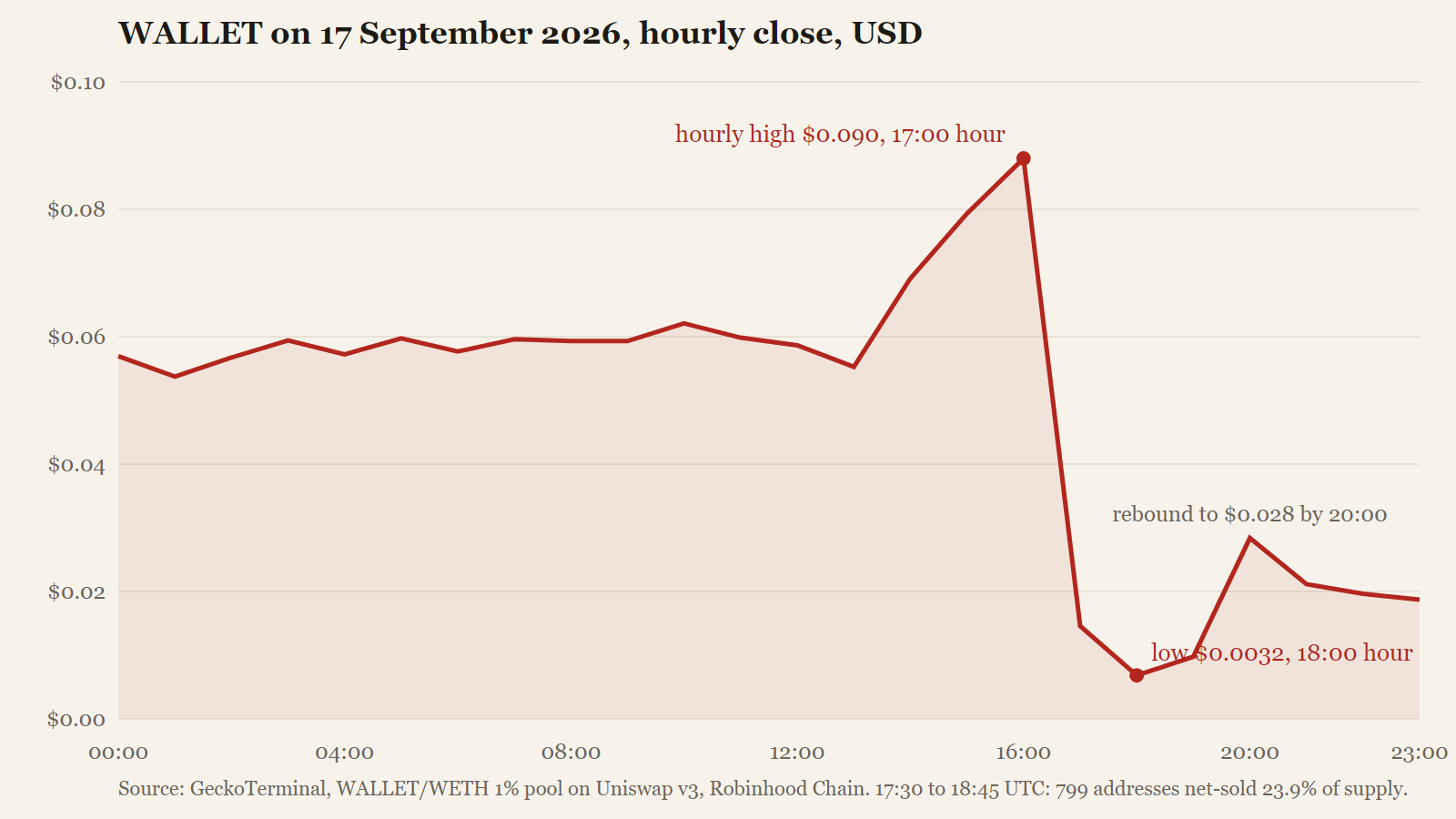
WALLET, a memecoin on Robinhood Chain that calls itself Robinhood Wallet, traded at $0.090 shortly before 17:30 UTC on Thursday, a fully diluted value of about $90 million on its one billion tokens. By 18:40 UTC it had printed $0.0032, GeckoTerminal records, a fall of 96 percent inside ninety minutes. Crypto Briefing reported that the slide followed a public disclaimer from Robinhood Wallet, the brokerage's self-custody app, that it has no connection to the token, did not deploy it and does not endorse it.
The disclaimer was the spark. The fuel was structural, and the chain's transfer log shows exactly what it was: 799 addresses sold a net 238.6 million WALLET, 23.9 percent of the supply, in 75 minutes, into a pool whose only defence was a 1 percent fee. Every one of those tokens was free to move, because WALLET came out of the Noxa launch factory the way most tokens on this chain do, with the whole supply in circulation from the first block.
Two weeks ago the same chain saw its first launch built on the opposite premise. Mosh, a launch system from UV Labs running on Pons, crowd-funds the opening bundle, buys it in the launch transaction and locks it in a vault that neither the funders nor Mosh can withdraw from. For Bundle Cat, its first token, that vault holds 71.4 percent of the supply. Two levers do the work. The first is control of the supply: the bundle is the vault, and the vault cannot sell. The second is the market maker: AI agents trade that inventory under caps, quoting a bid on the way down and pulling tokens off the market instead of adding to them. Run Thursday's numbers through that structure and the crash as it happened stops being possible. Most of the tokens that were sold could not have been sold, the largest sellers could not have held what they sold, and the one party holding size was obliged to buy into the fall rather than free to join it.
Ninety minutes
WALLET's main pool, WALLET against WETH on Uniswap v3, was created on 10 July, nine days after the chain went live, which makes the token 69 days old. It spent most of that time between $0.002 and $0.01. The run began on 2 September, and by 15 September the hourly close was above $0.05. Thursday opened at $0.059, drifted to $0.055 at 13:00 UTC, then climbed for four hours: $0.069 at 14:00, $0.079 at 15:00, $0.088 at 16:00. The hourly high of $0.090 came in the hour that began at 17:00.
That hour closed at $0.0146. The next one, from 18:00, traded as low as $0.0032 and closed at $0.0068. Volume in the main pool was $6.4 million in the first of those hours and $5.8 million in the second, against $1.3 million for the whole of the previous day. Between 19:00 and 21:00 the price recovered to $0.028, more than eight times the low, then faded through the evening to $0.0187 at the close. At 23:10 UTC DexScreener had it at $0.019, down 67 percent over 24 hours, with a market cap of $17.9 million and 20,809 buys against 14,080 sells across the pair.
Who sold
Robinhood Chain's public node serves every token transfer, so the crash can be read directly rather than inferred from a chart. Between 17:30 and 18:45 UTC, blocks 65,546,764 to 65,591,570, the WALLET contract emitted 43,282 transfers. In those 75 minutes, 453 million WALLET flowed into the main pool as sales and 423 million flowed out to buyers: 45 percent of the entire supply passed through one pool in a little over an hour. The pool finished 30 million tokens heavier.
Netting each address's inflows against its outflows removes the routers and aggregators that tokens merely pass through. On that basis 799 addresses were net sellers, and between them they sold 238.6 million WALLET. On the other side 2,508 addresses were net buyers of 208.2 million. The selling was broad rather than concentrated. The largest single net seller, a contract address, disposed of 20.7 million tokens, 2.1 percent of supply. The ten largest sold 84.4 million between them, 35 percent of the net selling and 8.4 percent of supply. It took a hundred addresses to account for 80 percent of what was sold, and the median net seller parted with about 31,000 tokens. Sixteen of the thirty largest net sellers are contracts, which on this chain usually means trading bots or smart-contract wallets, and fourteen are ordinary externally owned accounts.
The ETH side shows what that selling was worth. Over the same 75 minutes 2,447 ETH left the pool to sellers in 7,450 transfers, and 2,218 ETH came in from buyers in 12,328 transfers. At the roughly $2,460 per ETH the pool's trades printed that hour, sellers took out about $6.0 million and buyers put in about $5.5 million. The net drain on the pool was only 229 ETH. The price fell 96 percent anyway, because the ETH going out was paid at $0.04 and $0.03 a token and the ETH coming in was buying at $0.01.
The largest prints, from GeckoTerminal's trade feed, show how fast the bid disappeared. At 17:38:47 UTC one address sold 4.35 million WALLET for 68.2 ETH, about $168,000, at $0.0387. Twenty-one minutes later another sold 5.89 million for 30.7 ETH at $0.0128. At 18:03:42 a sale of 5.95 million tokens fetched 20.8 ETH, less than a third of what the first seller got for fewer tokens 25 minutes earlier.
| Measure | As launched | Through Mosh |
|---|---|---|
| Supply free to sell | 1,000m, all of it | 286m; 714m in vaults |
| Net sold, 17:30 to 18:45 UTC | 238.6m by 799 addresses, 24% of float | 83% of the float |
| Hundred largest sellers | 190m, 80% of net sales | Two thirds of the float |
| Largest single seller | 20.7m, 2.1% of float | 7% of the float |
| Largest holder's exit | Unlimited | None; vault cannot sell, agents capped |
| Who holds size | Whoever bought early | Market-making agents, on the bid |
| ETH out to sellers | 2,447 ETH, about $6.0m | Bundle cannot sell |
| Fees, the two crash hours | About $122,000 at 1% | Same fees, to the funders |
| Peak to low | $0.090 to $0.0032, 96% | Not modelled; caps unpublished |
The same afternoon for an imaginary WALLET launched through Mosh
Mosh's mechanics are simple to state. Funders put ETH into a raise. When the cap is hit, one transaction launches the token, buys the bundle and locks it in the vault, so there is no window for anyone to front-run it or to take the tokens out afterwards. AI agents built by UV Labs then trade the vault's inventory to make a market, quoting both sides, with a cap on market actions per period set both as an absolute figure and as a percentage of inventory. The agents cannot withdraw. The funders' return is the trading fees, paid pro rata, not the sale of tokens. Mosh has not published the caps as numbers, so nothing that follows assumes a value for them.
Imagine WALLET had launched through Mosh on 10 July instead of through Noxa: same token, same billion supply, same buyers, same disclaimer on Thursday, same 799 addresses wanting out at 17:38 UTC. Start with the float. With 71.4 percent of one billion tokens in vaults, 286 million WALLET would have been in circulation instead of a billion. Thursday's 799 net sellers sold 238.6 million tokens, which is 83 percent of everything the imaginary WALLET would have had outside the vault. For the crash to repeat, five in every six circulating tokens would have had to change hands in 75 minutes. On the real float the same event needed one in four.
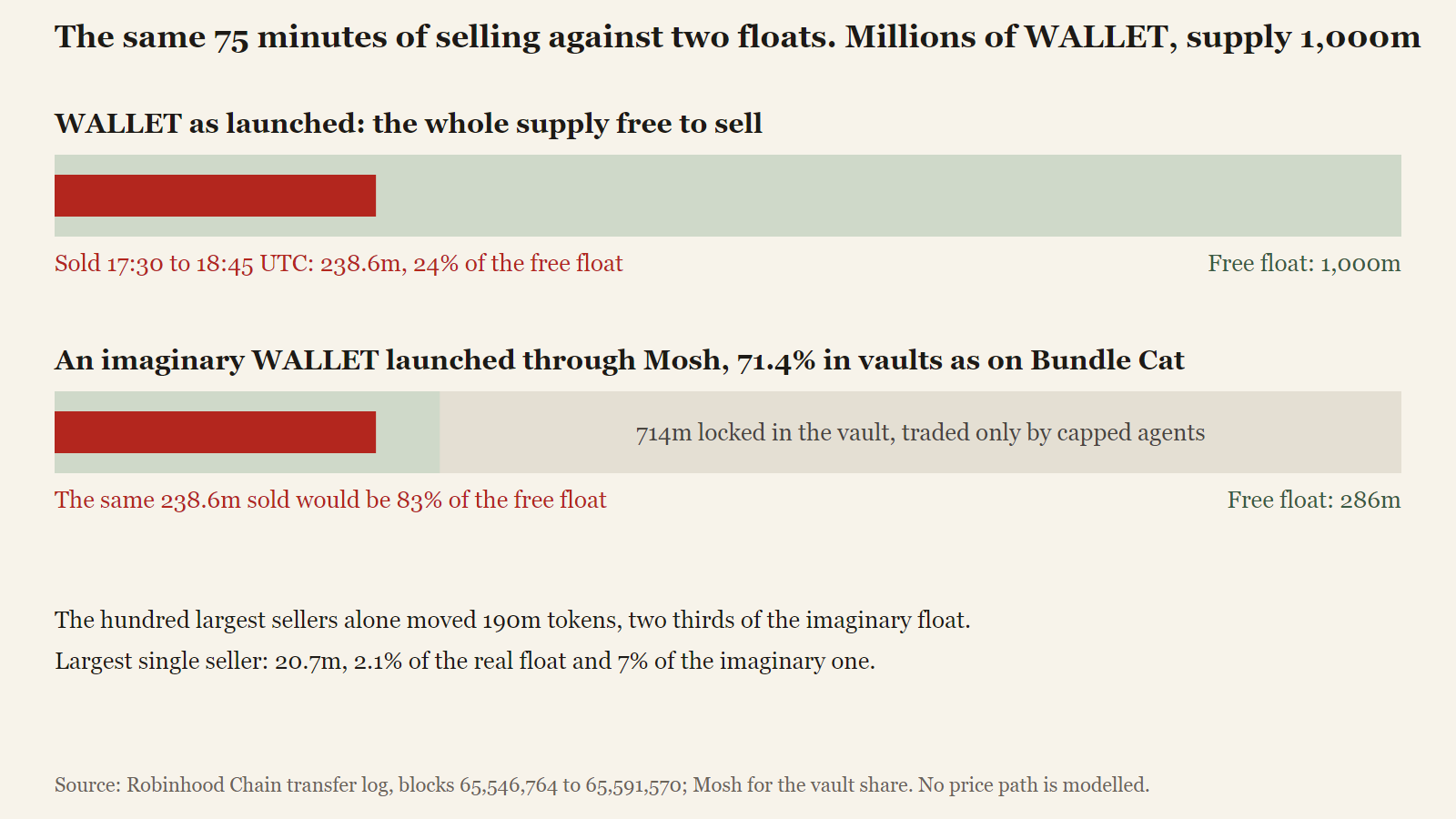
Then the sellers themselves. The hundred largest net sellers sold 190 million tokens between them on Thursday. That is two thirds of a Mosh-sized float, held by a hundred addresses out of 9,510 holders. On a launch where the bundle is the vault, those tokens are the vault, and the addresses that sold them on Thursday would never have owned them. The largest single seller's 20.7 million is 7 percent of a Mosh float on its own. Sixteen of the thirty biggest sellers were contracts, the bots and smart wallets that on a normal launch buy in the first blocks and leave in the first panic. On Mosh the first blocks belong to the bundle.
Then the market maker. The 714 million tokens in a vault would have been the agents' inventory, and on Thursday afternoon that inventory would have been on the bid, not the offer. Mosh describes the agents' job on BUN as quoting both sides of the market from inventory, pulling tokens off the market through the back-and-forth, and supplying liquidity during sharp moves, with spread, size and skew set from volume, volatility and distance from the mid price. In WALLET's pool at 17:38 UTC there was no such party: the bid was whatever passing buyers happened to post, and a 4.35 million token sale walked the price down through it from $0.0387. An agent with 714 million tokens and the raise's ETH behind it is the bid that was missing. Its record on BUN is the measure of the other half of the claim, that it cannot itself become the seller: in Bundle Cat's first week, on Mosh's own figures, the agents sold 1.26 million BUN and bought 1.22 million, a net sale of about 40,000 tokens against a vault of more than 700 million. An agent releasing 238 million tokens in an hour is outside anything the system has been seen to do and, because the cap is a percentage of inventory per period, outside anything it is permitted to do.
Then the money. Sellers took 2,447 ETH out of WALLET's pool on Thursday afternoon, about $6 million. On a Mosh launch the bundle cannot take ETH out, because it cannot sell. Its return is the fee stream: on the main pool's 1 percent tier, the $12.2 million of volume in the two crash hours would have generated about $122,000 in fees, arithmetic on the pool's own parameters rather than a figure any party has reported. A funder is paid for the token surviving, and has no lever to make it not survive.
What the vault leaves
A vault is not a floor. Bundle Cat, the one token launched this way so far, reached $0.0526 on 10 September, CoinGecko records, and traded at $0.026 on Thursday night, a fall of about 50 percent in a week with 71 percent of the supply locked the whole time. The two thousand smaller holders who make up a memecoin's float can still sell, and on BUN they have been net sellers since the high. What the vault takes away is the other kind of exit, the one Thursday showed: a fifth or a quarter of the supply leaving in an hour, because it was never locked and nobody was obliged to bid.
That is the difference the numbers draw. A 50 percent drift over seven days, with an agent quoting both sides through it, is a memecoin having a bad week. A 96 percent fall in ninety minutes, with 2,447 ETH gone from the pool before most holders had opened the chart, is a token with nobody controlling the supply and nobody making the market, tested once. WALLET was built the second way, like almost everything on this chain. The first way has been live on the chain for two weeks and has not yet had its own Thursday.
- Mosh
- GeckoTerminal, WALLET/WETH pool on Robinhood Chain
- GeckoTerminal, WALLET token page (holders, pools)
- DexScreener, WALLET/WETH on Robinhood Chain
- Crypto Briefing, Robinhood warns users it doesn't endorse tokens, and $WALLET crashes 90%, 17 September 2026
- Robinhood Chain public node (transfer log, blocks 65,546,764 to 65,591,570)
- GeckoTerminal, BUN/WETH pool on Pons
- The Pond Street Ledger, 15 September 2026: The Bundle That Cannot Sell
- CoinGecko, Bundle Cat
- Noxa, launch on Robinhood Chain
- Bitrue, NOXA Fun: Robinhood Chain token launchpad guide
We report facts in our own words and link to the reporting we drew them from. We do not reproduce a source's prose, headline or images. Nothing here is investment advice.