
The Hoods Draws Every Wallet That Moved a Coin on Robinhood Chain in the Last Six Hours. Here Is How to Read It
A chain publishes its transfers one at a time. The Hoods, a live map presented by UGLY, draws them all at once: 3.28 million transfers between 60,263 addresses in six hours, each coin's crowd in its own neighbourhood, with the newest trades running across the screen as they land. What it shows, where the figures come from, and what a community can do with it.
Disclosure: UGLY, which sponsors The Hoods, is a coin on Robinhood Chain built by the same team as this desk. The map is the second thing UGLY has built for the chain's communities, after the game UGLY RUN, and it lives at uglyonrobinhood.com/thehoods.
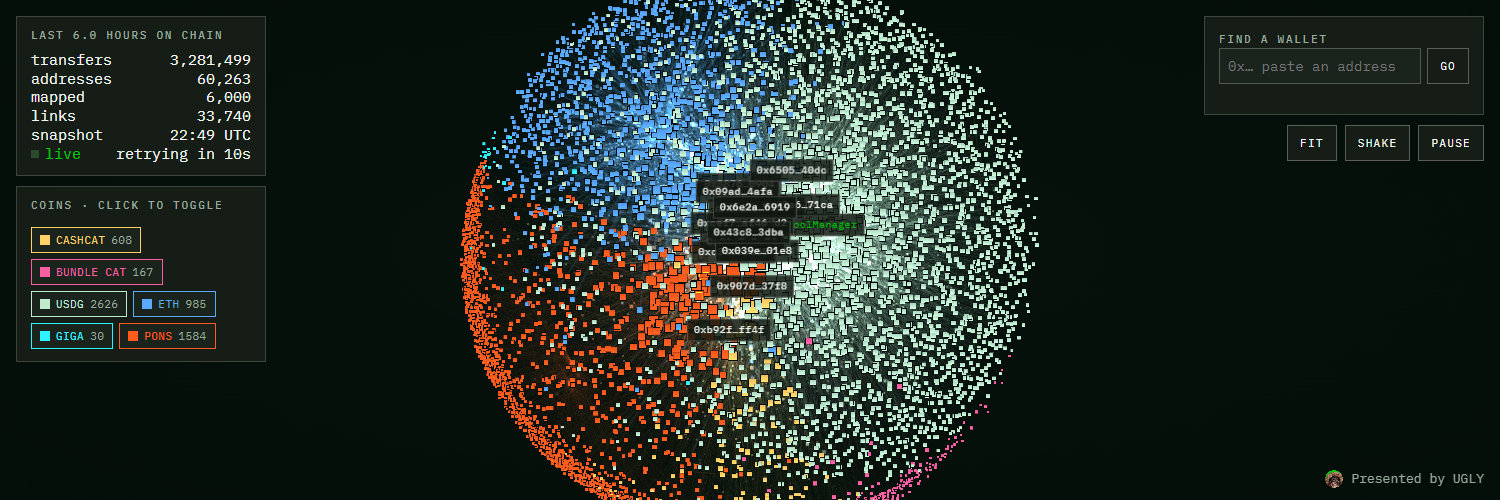
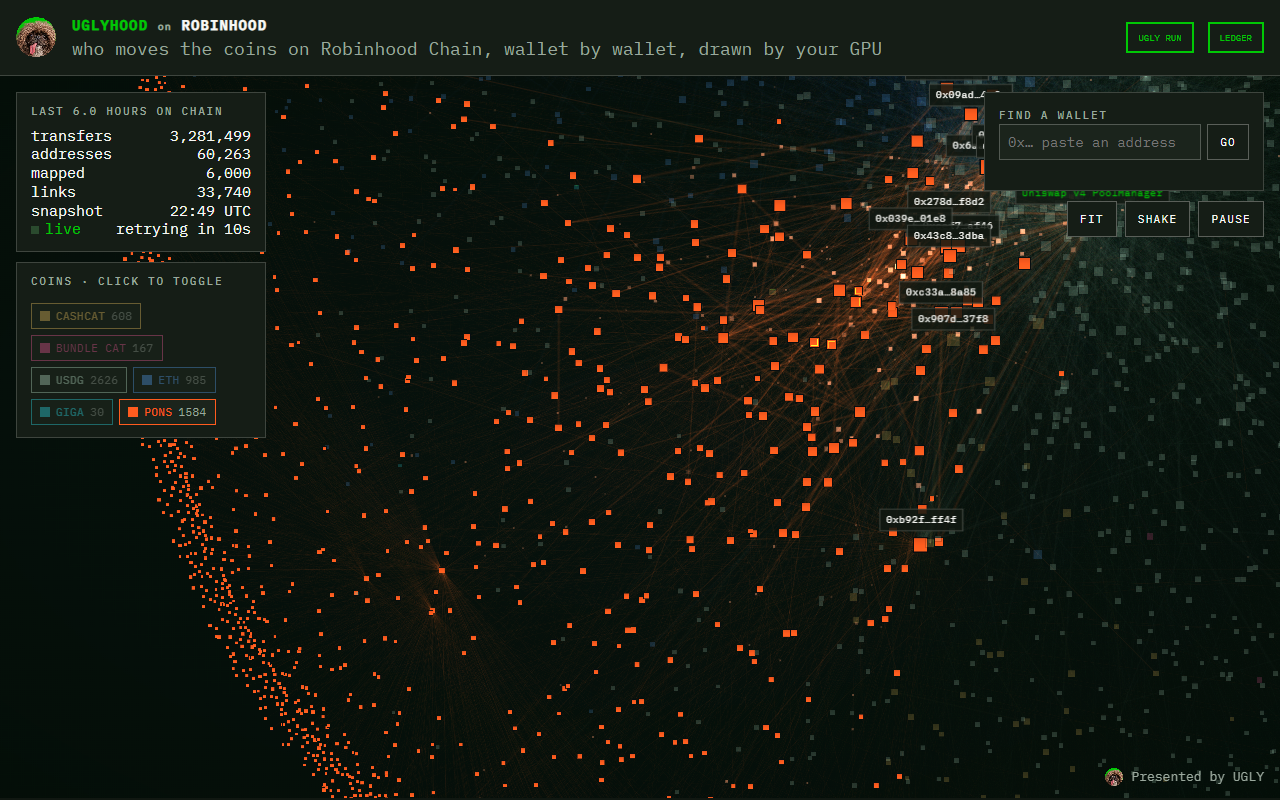
Open The Hoods and the screen fills with a ball of small squares. Each square is an address on Robinhood Chain that moved one of six tokens in the last six hours: PONS, Cash Cat, Bundle Cat, GIGA, USDG or ETH. A square is sized by how much it moved. A line between two squares is a transfer between them. Addresses that trade with each other are pulled together and everything else drifts apart, so each coin's crowd settles into its own neighbourhood, which the map calls a hood, and every address takes the colour of the coin it moves most. Liquidity pools wear a green ring. Sparks run from sender to receiver on the newest transfers, and they keep coming while the page is open, because the map reads the chain every few seconds.
In the six hours to 22:49 UTC on 15 September the map read 3,281,499 transfers between 60,263 addresses. USDG accounted for 1.64 million of those transfers and ETH for 1.53 million, which is the plumbing: almost every trade of a memecoin is paid for in one or the other. PONS was the largest memecoin hood, with 82,604 transfers by 7,907 addresses. Cash Cat had 22,332 transfers by 2,682 addresses, Bundle Cat 1,341 by 289, and GIGA 229 by 60.
What it tells you
The first thing is the size of a coin's crowd, measured as addresses that actually moved it rather than addresses that hold it. A holder count includes every wallet that bought once and left. The hood only includes wallets that did something in the last six hours, so it is closer to the number people mean when they say a coin is alive.
The second is whether the volume is many hands or a few. The page under the map lists the wallets that moved most. In that window the busiest PONS wallet made 73,895 transfers with 95 counterparties, and the next three PONS wallets made 63,192, 52,386 and 40,168. A wallet with dozens of counterparties and tens of thousands of transfers in six hours is a bot, a market maker or a custody address rather than a person. The map does not guess which; every card links to the explorer so a reader can look.
The third is the corners everyone passes through. Uniswap v4's PoolManager touched 430,580 transfers with 1,629 counterparties in the window, and five unlabelled contracts each dealt with more than 500 counterparties. Those are the routers and pools, and they sit in the middle of the picture because every hood trades through them. A coin whose crowd has no path to the middle is a coin nobody is swapping.
The fourth is overlap. An address that moves two coins sits between their hoods, so the seam between the PONS crowd and the Cash Cat crowd is made of wallets that trade both. That is a map of where a coin's next buyers already are.
Then there is the finder. Paste any address into the box at the top right. If the map knows it, the camera flies to it and pins its card: what it moved, how many counterparties, which hood it lives in. If the map does not know it, the browser fetches six hours of that wallet's history from the chain, seats it next to its first known counterparty and colours it by the coin it moved most. The address goes into the page's URL, so a link to a specific wallet can be shared.
Below the map is the cemetery. 483,496 tokens have been born on this chain, one stone per five hundred, and the green stones are the ones still trading. Half of everything born here stops trading within twelve hours. The full count, week by week, is the nursery.
Where the figures come from
Every transfer on the map is an ERC-20 Transfer event read from Robinhood Chain's public RPC, chain id 4663, for the six token contracts. A job rebuilds the picture every hour from the last six hours of blocks and publishes a summary. When the page is open, the browser asks the same public RPC for new blocks every five seconds and adds the transfers it finds as sparks; a wallet the map has not seen is spawned next to the wallet it traded with. The map keeps the 6,000 addresses with the most volume in the window and every link between them, 33,740 in that snapshot, and anything else joins the moment it trades. Pool names come from DexScreener. ETH is counted as WETH because native ETH leaves no event log.
The layout is a force simulation that runs on the graphics card through WebGPU, which is why a page with 6,000 moving squares and 4,000 sparks stays smooth on a laptop. Positions mean neighbourhood, not geography. There is no API key, no account and nothing to connect: the page never asks for a wallet, and the wallet finder is a text box. The source code and the data pipeline are public at github.com/Gioluan/uglyhood, and the hourly summary the Ledger's page prints is the same file the map reads.
What a community can do with it
Bundle Cat is the first community with a street of its own in UGLY RUN, and it is on the map for the same reason: a community that has a place in the game has a place on the chain, and the two can be checked against each other. In that window 289 addresses moved BUN. Its hood is at uglyonrobinhood.com/thehoods/?coin=BUN.
Link the hood. Opening the map with the coin's symbol in the address, for example uglyonrobinhood.com/thehoods/?coin=CASHCAT, lights that crowd and frames the camera on it. It is a link a community can pin in its Telegram or put in a bio, and it shows the crowd as it is now rather than as a chart of the price.
Watch a launch as it happens. A new coin's hood begins as a handful of squares around one pool. Open it during the launch and the new addresses appear and link up as the trades land, which is a different thing from watching a candle form.
Check a claim. When a project says it has five thousand holders, the hood shows how many addresses moved the coin in the last six hours. When it says the volume is organic, the movers table shows whether one wallet made seventy thousand of the transfers. Neither number settles an argument on its own, but both are things anyone can now see.
Check a wallet before trusting it. Paste the address that just offered to buy the community's tokens over the counter, or the one that just joined the group claiming to be a whale, and see what it moved, with whom, and in which hood it lives.
Ask for a coin. The six coins are a choice, not a limit. The pipeline reads any ERC-20 on the chain, and the desk will add a coin that trades.
What it does not do
It does not know who anyone is. An address is an address, and a hood is a pattern of transfers, not a membership list. It does not show balances or holders, only movement, so a wallet that bought a month ago and has sat still since is not on it. It does not keep history beyond six hours; the record lives on the coin pages and in the nursery. It does not show a price, and it needs a browser with WebGPU, which is current Chrome, Edge, Safari or Firefox.
| Coin | Transfers | Addresses that moved it | Share of the window |
|---|---|---|---|
| USDG | 1,640,863 | 43,417 | 50.0 percent |
| ETH | 1,534,130 | 11,943 | 46.8 percent |
| PONS | 82,604 | 7,907 | 2.5 percent |
| Cash Cat | 22,332 | 2,682 | 0.7 percent |
| Bundle Cat | 1,341 | 289 | 0.04 percent |
| GIGA | 229 | 60 | 0.01 percent |
Neither UGLY nor this desk is affiliated with Robinhood Markets.
- The Hoods on the Ledger
- The Hoods, full screen, on uglyonrobinhood.com
- Source code and data pipeline
- The nursery
- UGLY
We report facts in our own words and link to the reporting we drew them from. We do not reproduce a source's prose, headline or images. Nothing here is investment advice.