market structure
Every story this desk has filed under market structure, most recent first.
A token that tracks a share does not know what that share is worth. Something has to tell it, and that something is a chain of reporting, aggregation and publication with specific, documented failure points.
Tokenized equity venues look like exchanges but mostly are not. Understanding whether you are facing a hedged market maker, an issuer's inventory, or an automated pool explains almost every strange price you will ever see on one.
Three Tickers Carried 55 Percent of the Board
NVDA, SPY and META took $55.1m of $100.5m in 24-hour volume on Robinhood Chain this week, while 103 of the 196 listings did not trade at all.
Redemption is the pipe that connects a token's price to a share price. It is also the pipe most retail holders will never be allowed to use, and understanding why explains most of what a stock token is.
The IMF Says Tokenised Stock Markets Are Thinner and More Volatile Than the Real Ones
The International Monetary Fund found that tokenised equity markets trade with less liquidity and sharper price swings than the share markets they mirror, even as demand for round-the-clock trading grows.
Every order on a layer 2 passes through a single piece of software that decides what happened and in what order. Here is what that machine controls, what it cannot control, and where the failure modes sit.
A stock token has no automatic link to the share it names. The price holds because someone can profitably move between the two, and the explainer is really about who that someone is and what stops them.
The CFTC Proposes a Federal Licence for Crypto Exchanges, With Leverage as the Trigger
Two proposed rules would create a new category of registered venue for leveraged retail crypto trading. A reform group says the derivatives regulator is the wrong one for the job.
Tokenised Stocks Did $3.96bn of Weekend DEX Volume, 106 Times Last November
Decentralised exchange volume in tokenised equities reached $3.96bn over the weekend, according to a Crypto Briefing report, a 106-fold increase on November levels and a direct consequence of stock tokens trading when the exchanges are shut.
Every tokenized equity rests on a promise from a legal entity that it holds the share and will hand over the value. This is what that promise is worth in an insolvency, and which structural choices decide it.
A tokenised share trades every minute of the week. The share itself trades for about 32 hours of it. The gap between those two facts is the whole business of overnight market making, and it is paid for in the spread.
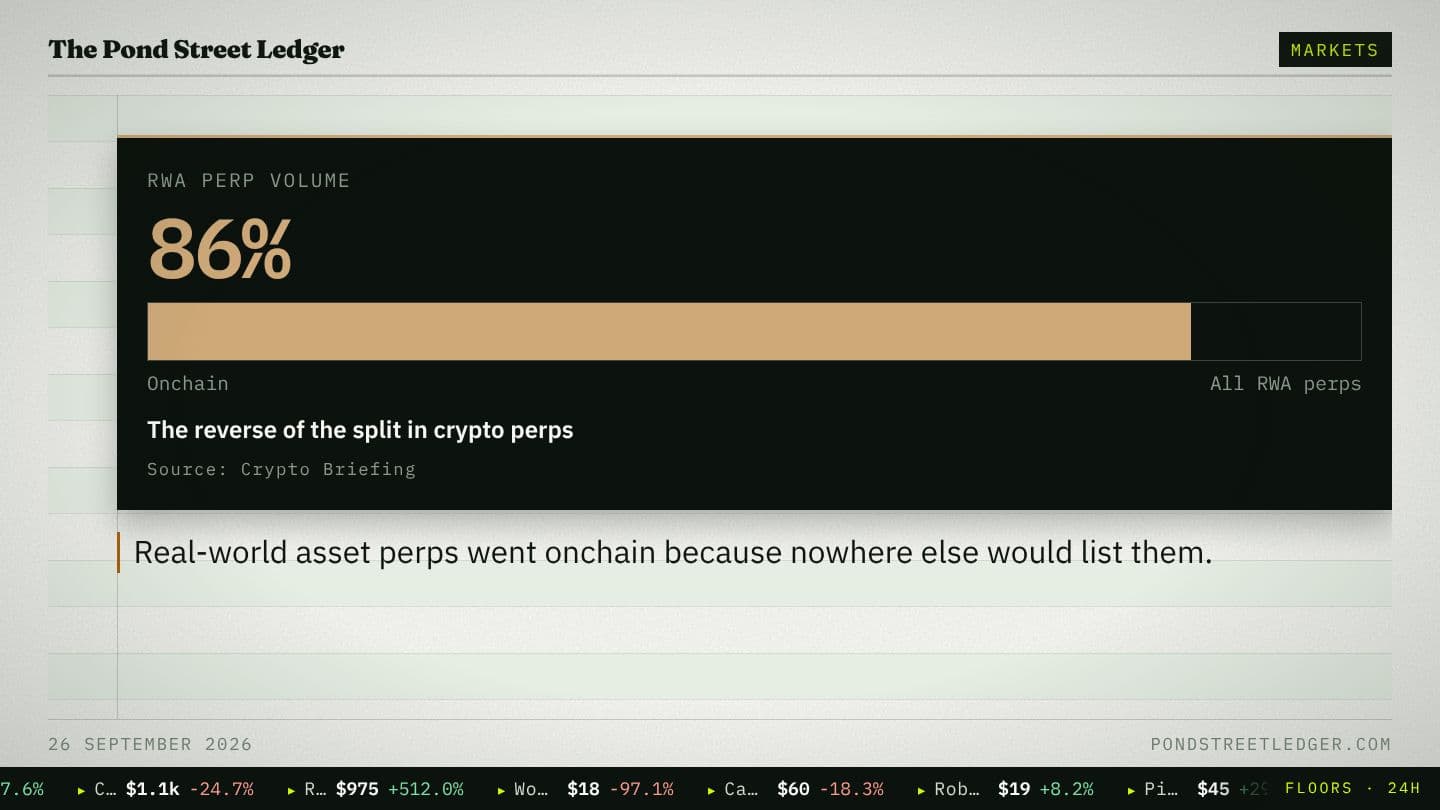
Most Real-World Asset Perpetuals Now Trade Onchain
Eighty-six percent of perpetual futures volume on real-world assets is settling on decentralised venues rather than centralised ones, according to Crypto Briefing.
A tokenized share is a claim that passes through a broker, a custodian, a central securities depository and an issuer before it reaches your wallet. Knowing which link fails first is the whole analysis.
Every tokenized equity claims one-to-one backing. The differences that matter sit in who holds the shares, whose balance sheet they are on, and what the attestation is allowed to say.
Every tokenized equity is a claim that depends on one queue: the redemption window where tokens go back to the issuer and shares or cash come out. Here is how that window works, what closes it, and what your token trades on when it is shut.
A tokenized equity only trades as well as somebody's balance sheet allows. This is a walk through the three kinds of market maker standing behind an onchain share, the hedge each one runs, and the hours when all of them step back.
Almost every tokenized equity trade on a Layer 2 passes through a single machine that decides which transaction goes first. Here is what that machine can and cannot do to you, and what the escape hatch actually is.
In listed equity markets a clearing house stands between buyer and seller and guarantees the trade. Onchain there is no such party. The risk does not vanish, it moves to the issuer, the venue and the pool.
The Robinhood Chain memecoin fell from $0.090 to $0.0032 on Thursday afternoon when 799 addresses sold 24 percent of the supply in 75 minutes with nothing in the way. Take the same token, the same sellers and the same afternoon, and launch it through Mosh instead: 71 percent of the supply sits in a vault nobody can sell from, the sellers would have needed 83 percent of the float, and the only large holder is a capped market maker.
A tokenized share is not the share. It is a claim that a market maker can usually, but not always, convert back into one. The size of the gap between the two prices is a readout on how hard that conversion is at any given moment.
A tokenized stock trade settles the moment the block confirms. The share behind it still settles the next business day. Everything interesting in onchain equities lives in that gap.
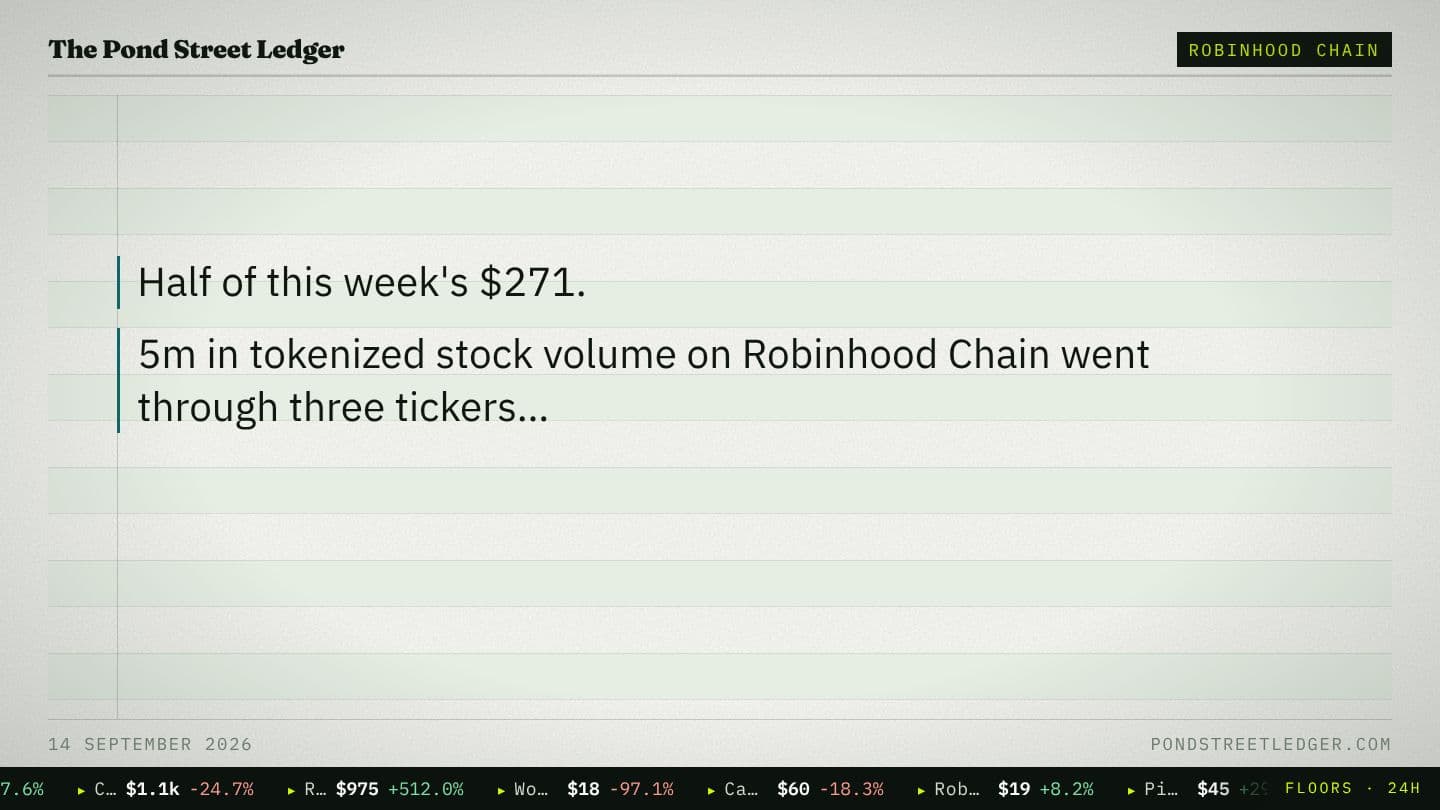
Three tickers, half the volume: 41 listings sat out the week
Half of this week's $271.5m in tokenized stock volume on Robinhood Chain went through three tickers, and 41 of the 196 listings did not trade at all.
Total value locked gets the headlines, but stablecoin supply is the harder number to fake and the one that tells you what a chain is actually for. Here is how the two relate, and what the ratio between them means.
A tokenized equity is only as good as the chain of custody underneath it. Here is who holds the underlying share, where the token sits in the legal queue, and what each link can do to you.
A stock token trades in an automated pool that has no idea what the share is worth. Everything that keeps the two numbers together, arbitrage, oracles, redemption, depends on a price feed that closes when the exchange does.
Secondary trading in tokenized equities is visible on any block explorer. The primary market that mints and burns the tokens is not, and it is the mechanism that decides whether the price on the screen means anything.
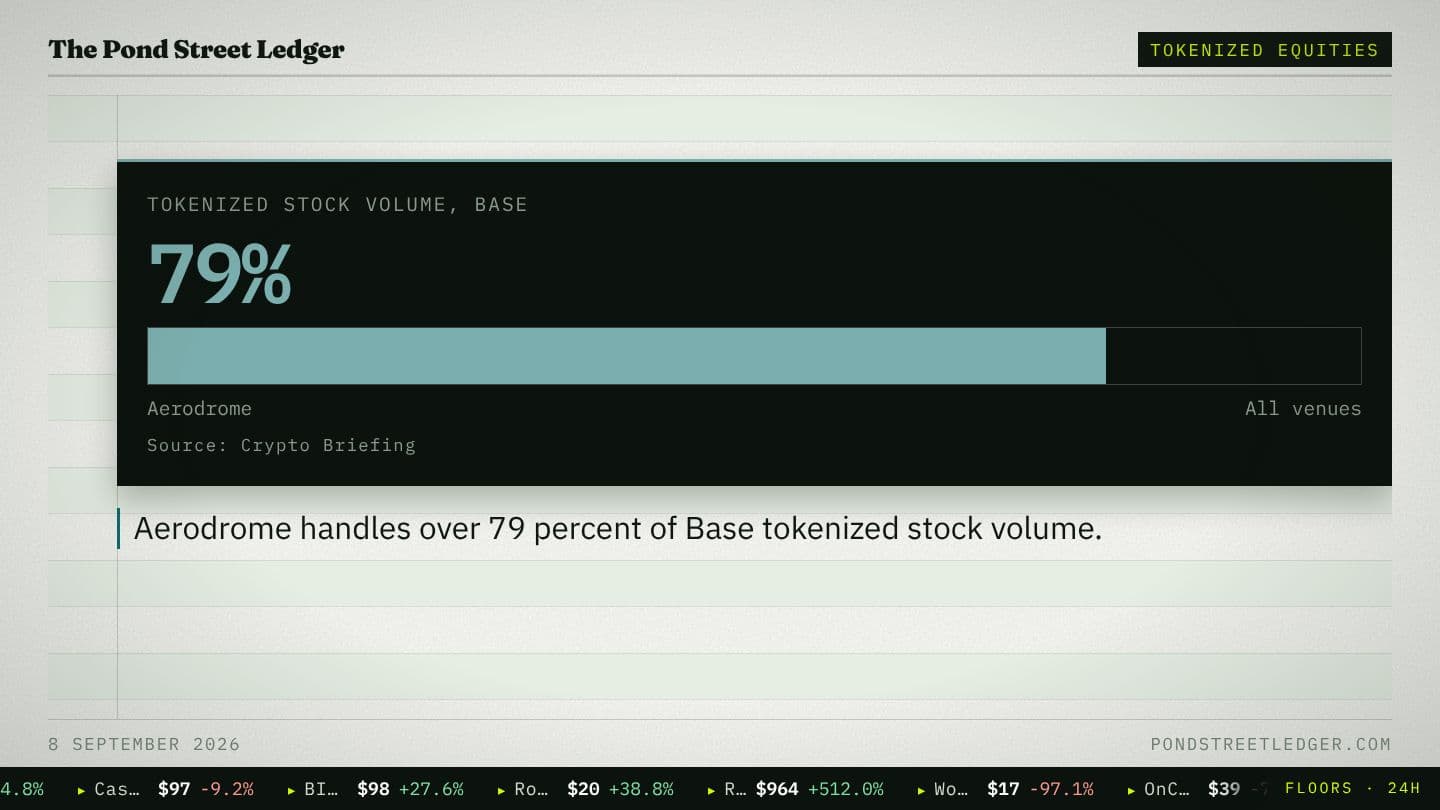
One Venue Takes Four Fifths of Base's Tokenized Stock Volume
Aerodrome accounts for more than 79 percent of tokenized equity trading on Base, according to Crypto Briefing, which makes a single automated market maker the effective order book for the asset class on that chain.
Almost every tokenized-equity chain, Robinhood Chain included, runs behind a single ordering machine. Here is what that machine decides, what it cannot decide, and what your position looks like during an outage.
A tokenized share does not trade against an order book. It trades against a curve, and on most chains that curve is built from ranges chosen by a handful of providers. Here is how the depth actually gets there, and what happens when it leaves.
A trading halt is a feature of a specific venue, not a property of a company. Tokenized equities sit outside that venue, which creates a market that keeps quoting a price nobody can hedge.
Every onchain equity trade has two legs, and only one of them is the stock. The other leg is a stablecoin, and that substitution is where most of the risk, the cost and the regulatory argument actually sits.
The equity market is closed for roughly two thirds of the week, but the token is not. Someone has to quote a price with no hedge available, and the way they cover that risk is the whole cost of 24/7 trading.
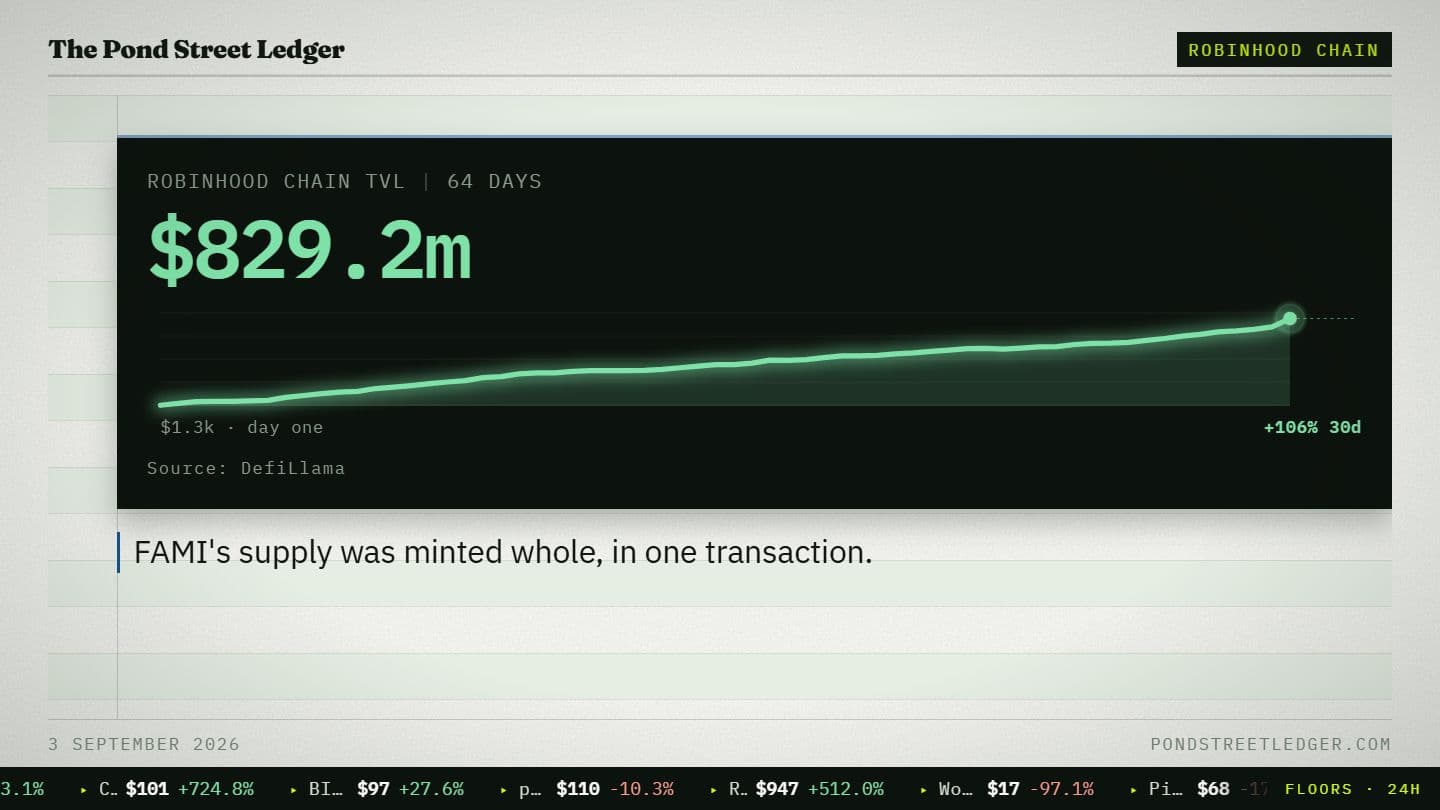
The Token That Moved a Nasdaq Stock Was Never a Stock Token
FAMI, the asset traded against the Money Mushroom memecoin on Robinhood Chain, was minted in one transaction with a supply close to Farmmi's entire share count. Farmmi's Nasdaq listing then traded roughly 90 times its usual volume.
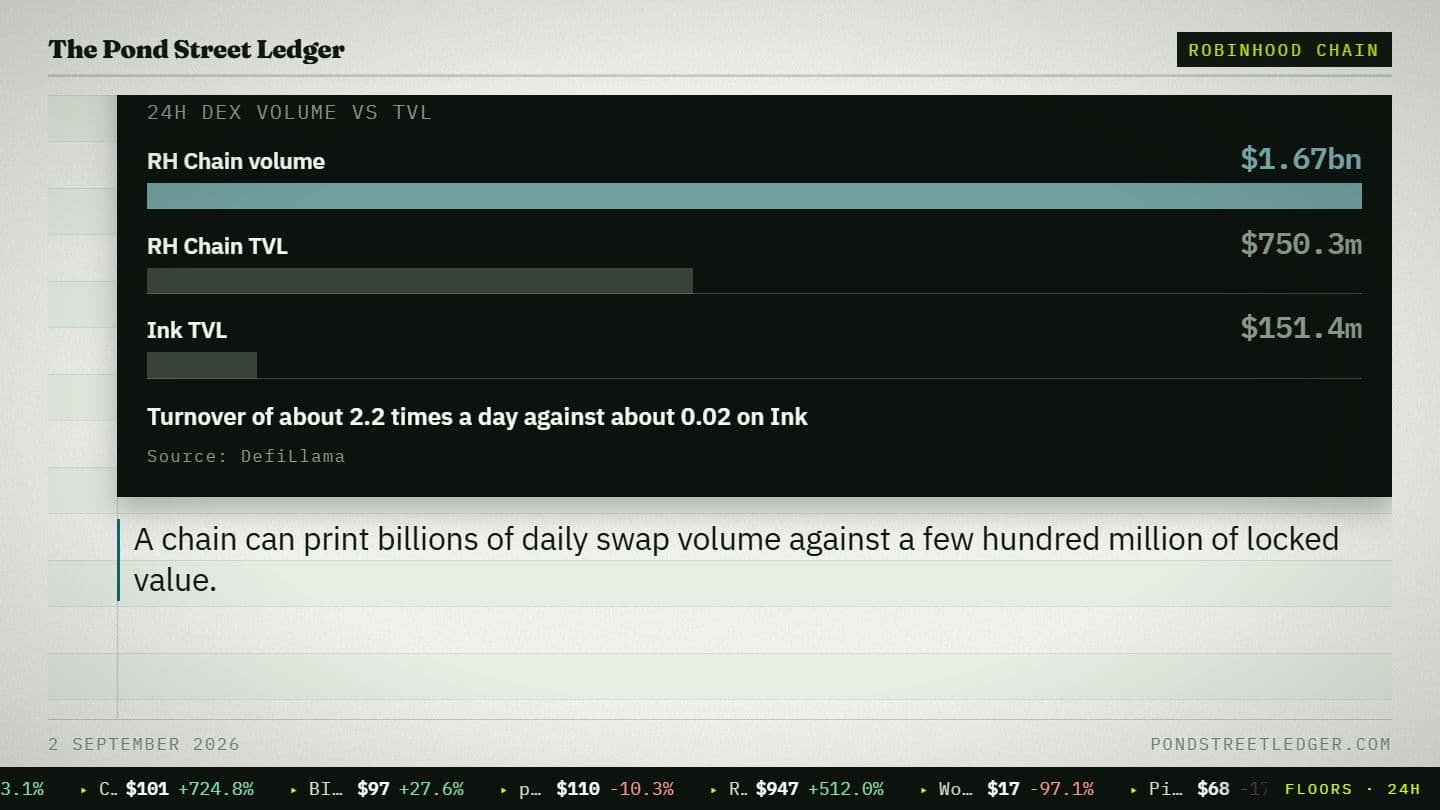
Velocity, Not Depth: What DEX Volume to TVL Actually Tells You
A chain can print billions of daily swap volume against a few hundred million of locked value. The ratio is not a scandal or a badge of honour, it is a description of what kind of liquidity the chain has, and it can be gamed.
Tokenized Stocks Get a Request-for-Quote Desk on Hyperliquid
Silhouette has launched RFQ trading for xStocks on Hyperliquid, letting market makers bid against each other for tokenized equity orders that settle onchain. It is an answer to the thinnest part of this market: the spread.
Who Actually Holds the Shares Behind a Tokenized Stock, and What They Owe You
Every tokenized equity sits on top of a chain of custody that ends at a real share certificate held by a real institution. Understanding who is holding what, under which legal wrapper, tells you what happens when something goes wrong.
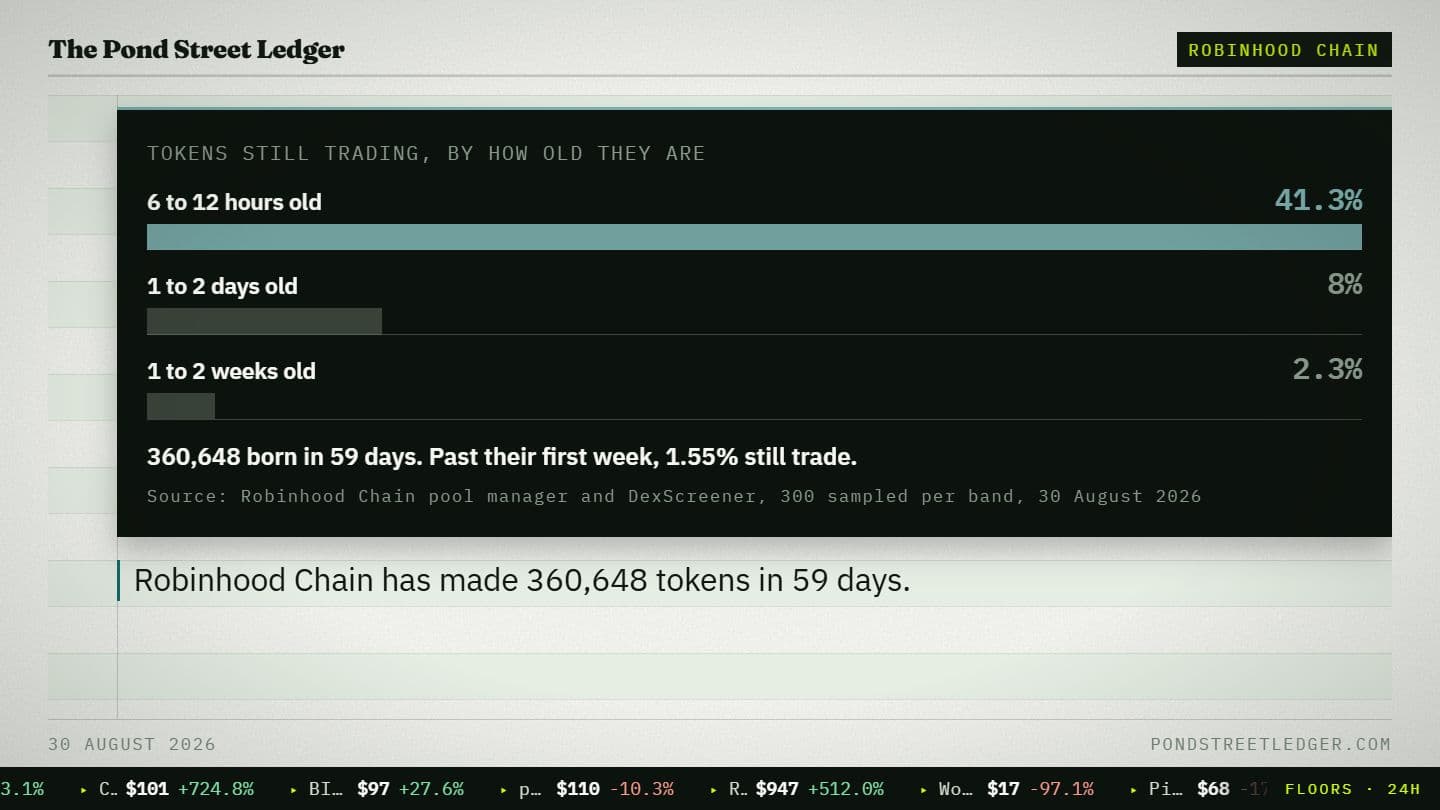
Ninety-Eight Per Cent of the Tokens Born on Robinhood Chain Are Dead Within a Fortnight
The chain has made 360,648 tokens in 59 days, about 6,100 a day. Of those more than a week old, 1.55 percent traded yesterday: about one in sixty-five. Half of everything born here stops trading before it is twelve hours old.
Robinhood Chain settled more DEX volume in a day than it holds in total value locked. That is not a contradiction, it is a statement about how often the same dollar gets reused, and it is one of the few ratios on a public chain that is hard to fake.
What Settlement Really Means When a Tokenized Stock Changes Hands
The token moves in a block. The share behind it usually does not. This is the gap between onchain finality and the legal transfer of ownership, and who carries the risk while it is open.
What Happens to Your Token When the Company Splits, Merges or Gets Bought
Dividends are the easy corporate action. Splits, mergers, delistings and tender offers are where tokenized equity wrappers actually get tested, because each one changes what the token is supposed to represent.
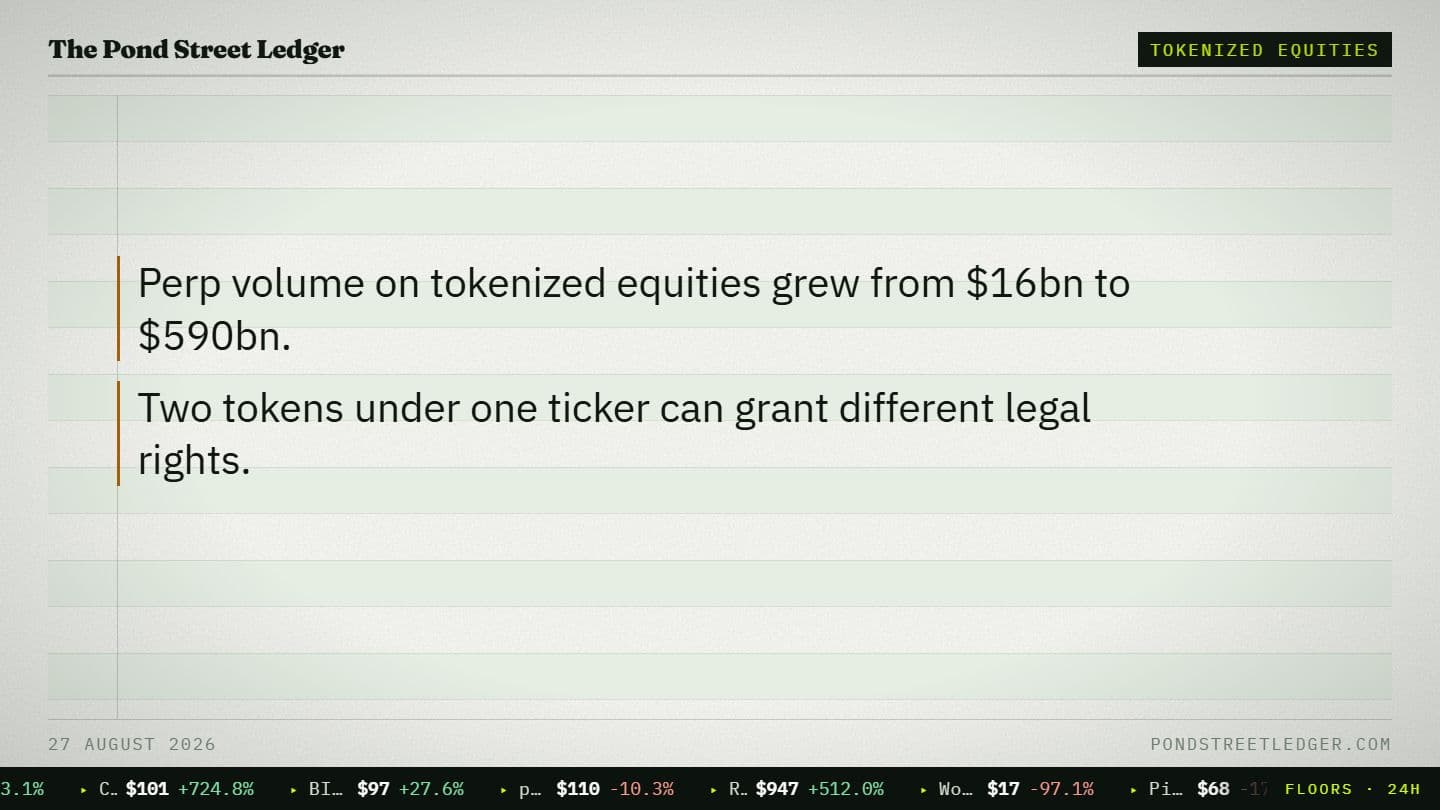
Tokenized Equity Volume Went From $16bn to $590bn, and Nobody Agrees What the Tokens Are
CoinDesk's indices desk puts perpetual futures volume on tokenized equities at more than $590bn over a year, up from $16bn. The growth is not the interesting part. Two tokens under one ticker can carry entirely different rights.
Japan Starts Studying Blockchain Settlement for Its Own Stock Market
Nikkei reports that Japanese agencies are working on a blockchain-based stock settlement system, with details due in early 2027 and full operation not expected until the early 2030s.
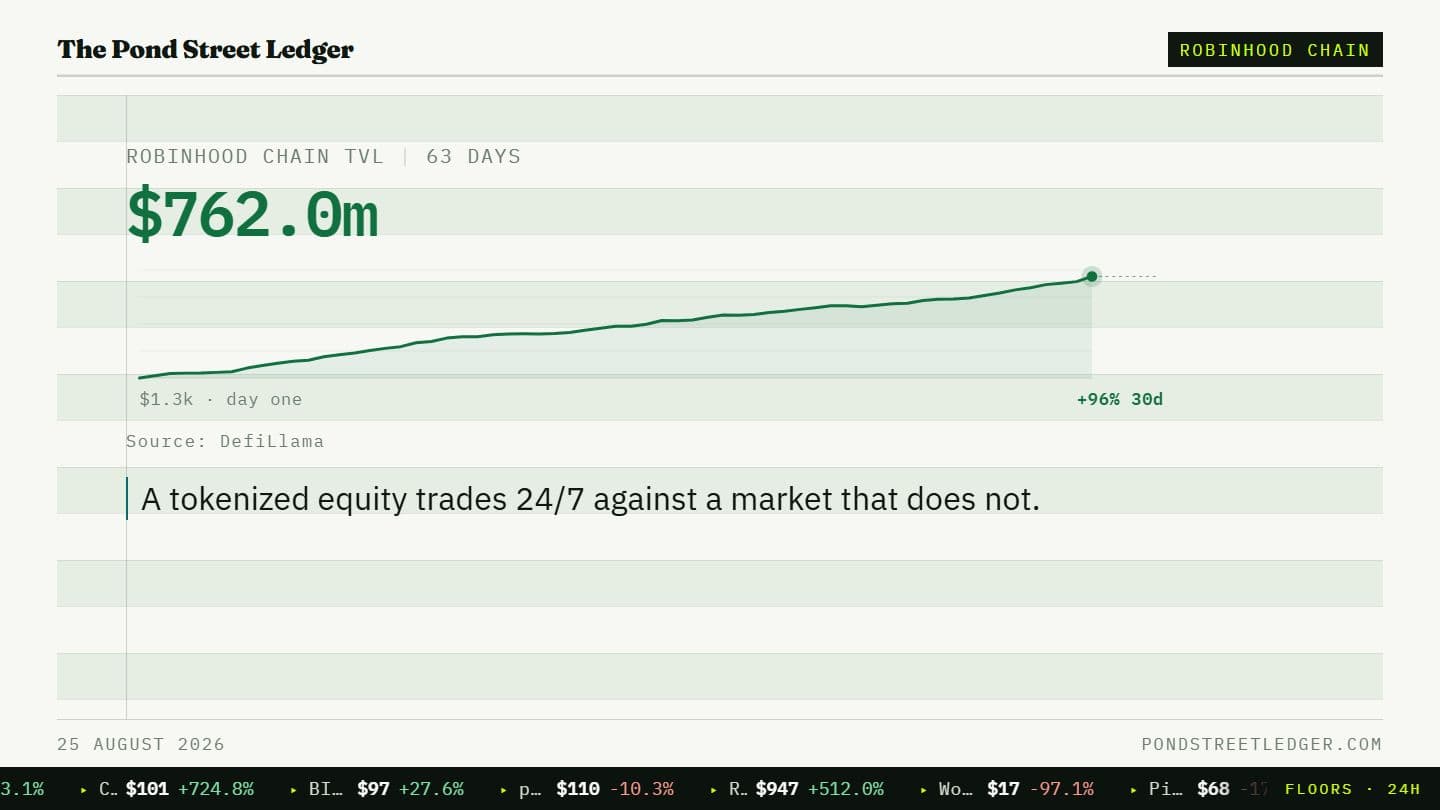
Who Actually Provides Liquidity for a Tokenized Stock, and What Happens at 4pm
A tokenized equity trades 24/7 against a market that does not. This explainer walks through who quotes it, how they hedge, and why spreads widen the moment the underlying venue closes.
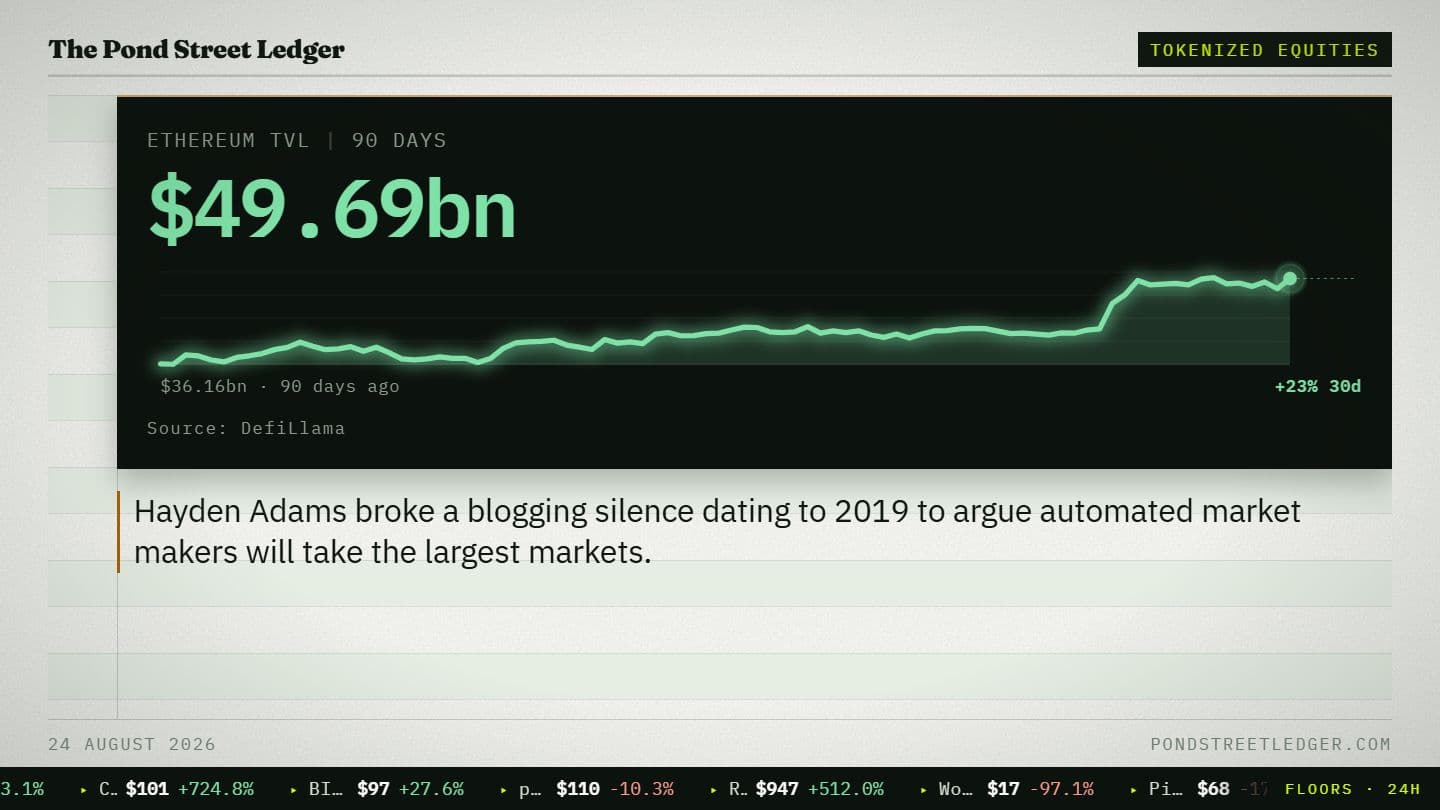
Uniswap's Founder Says Tokenized Stocks Should Trade Against Index Funds, Not Dollars
Hayden Adams broke a blogging silence dating to 2019 to argue automated market makers will take the largest markets. A former XTX trader replied that they are heading to zero.
What a Tokenized Stock Actually Is, and What You Own When You Hold One
A tokenized stock is almost never the share. It is a claim on someone who holds the share, wrapped in code, and the quality of your position depends entirely on who that someone is.