explainer
Every story this desk has filed under explainer, most recent first.
A token that tracks a share does not know what that share is worth. Something has to tell it, and that something is a chain of reporting, aggregation and publication with specific, documented failure points.
Tokenized equity venues look like exchanges but mostly are not. Understanding whether you are facing a hedged market maker, an issuer's inventory, or an automated pool explains almost every strange price you will ever see on one.
A share pays its holder on a record date fixed by the issuer. A token pays whoever a smart contract says held it, after a custodian has been paid, after tax has been withheld, and usually in something other than the dividend itself.
Mergers, delistings, reverse splits and ticker changes all end the life of a share as it was registered. The token tracking it has to be unwound, reissued or frozen, and the rules for that live in the issuer's documents rather than in the contract.
Issuers of tokenized equities publish attestations, proof-of-reserve feeds and holdings tables, and each one answers a different question. A guide to reading what is there, and noticing what is not.
Every tokenized equity rests on a promise from a legal entity that it holds the share and will hand over the value. This is what that promise is worth in an insolvency, and which structural choices decide it.
A tokenised share trades every minute of the week. The share itself trades for about 32 hours of it. The gap between those two facts is the whole business of overnight market making, and it is paid for in the spread.
A share does things while you hold it. It pays dividends, splits, gets taken over and votes. An explainer on how each of those events is supposed to travel from the share register to a token balance, and the places the signal gets lost.
A tokenized share is a claim that passes through a broker, a custodian, a central securities depository and an issuer before it reaches your wallet. Knowing which link fails first is the whole analysis.
Every tokenized equity is a claim that depends on one queue: the redemption window where tokens go back to the issuer and shares or cash come out. Here is how that window works, what closes it, and what your token trades on when it is shut.
A tokenized equity only trades as well as somebody's balance sheet allows. This is a walk through the three kinds of market maker standing behind an onchain share, the hedge each one runs, and the hours when all of them step back.
Almost every tokenized equity trade on a Layer 2 passes through a single machine that decides which transaction goes first. Here is what that machine can and cannot do to you, and what the escape hatch actually is.
In listed equity markets a clearing house stands between buyer and seller and guarantees the trade. Onchain there is no such party. The risk does not vanish, it moves to the issuer, the venue and the pool.
A tokenized share is not the share. It is a claim that a market maker can usually, but not always, convert back into one. The size of the gap between the two prices is a readout on how hard that conversion is at any given moment.
A tokenized stock trade settles the moment the block confirms. The share behind it still settles the next business day. Everything interesting in onchain equities lives in that gap.
Corporate actions are the hardest unglamorous problem in tokenized equities. The share does something, and a token contract has to be told about it in time. Here is the mechanism, and where it fails.
A tokenized stock is two claims stacked on top of each other: a token you control and a share someone else holds for you. Insolvency is the moment those two things get tested against each other.
A tokenized equity is only as good as the chain of custody underneath it. Here is who holds the underlying share, where the token sits in the legal queue, and what each link can do to you.
Secondary trading in tokenized equities is visible on any block explorer. The primary market that mints and burns the tokens is not, and it is the mechanism that decides whether the price on the screen means anything.
A tokenized share does not trade against an order book. It trades against a curve, and on most chains that curve is built from ranges chosen by a handful of providers. Here is how the depth actually gets there, and what happens when it leaves.
A share is not a static object. It pays, it converts, it gets bought out and sometimes it stops existing. Here is how each of those events travels from a company's board resolution to a token in a self-custodied wallet, and where the chain stops being able to help.
Every onchain equity trade has two legs, and only one of them is the stock. The other leg is a stablecoin, and that substitution is where most of the risk, the cost and the regulatory argument actually sits.
The equity market is closed for roughly two thirds of the week, but the token is not. Someone has to quote a price with no hedge available, and the way they cover that risk is the whole cost of 24/7 trading.
The Hardest Problem in Tokenized Equity Is Not Trading, It Is a Stock Split
A tokenized share is easy to move and hard to adjust. Corporate actions, splits, dividends, mergers, spinoffs, force the token to answer for something that happened off the chain, and there is no single accepted way to do it.
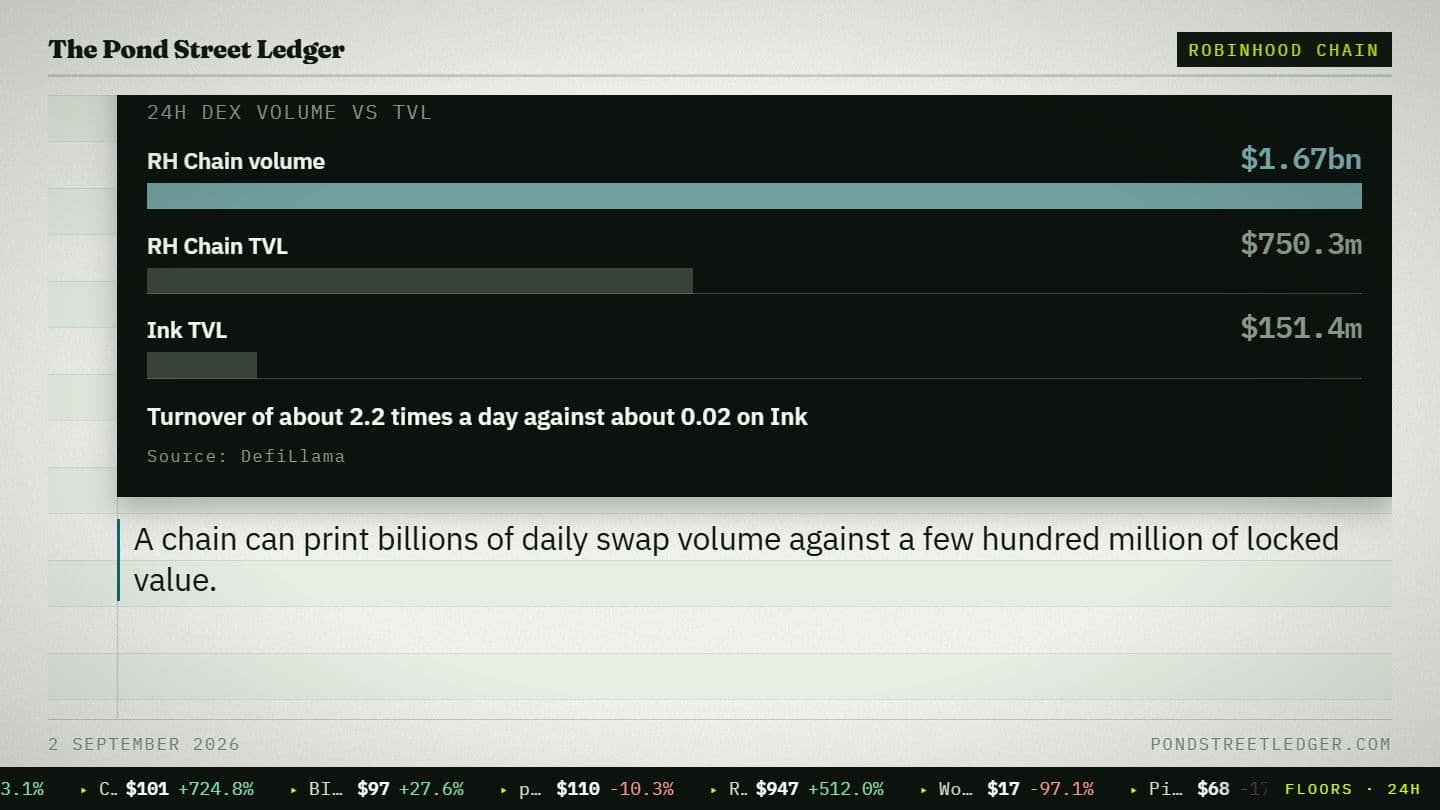
Velocity, Not Depth: What DEX Volume to TVL Actually Tells You
A chain can print billions of daily swap volume against a few hundred million of locked value. The ratio is not a scandal or a badge of honour, it is a description of what kind of liquidity the chain has, and it can be gamed.
Who Actually Holds the Shares Behind a Tokenized Stock, and What They Owe You
Every tokenized equity sits on top of a chain of custody that ends at a real share certificate held by a real institution. Understanding who is holding what, under which legal wrapper, tells you what happens when something goes wrong.
Every issuer says the tokens are fully backed. The question worth asking is what the backing is, who holds it, who checks, and what you can do if the answer turns out to be wrong.
Robinhood Chain settled more DEX volume in a day than it holds in total value locked. That is not a contradiction, it is a statement about how often the same dollar gets reused, and it is one of the few ratios on a public chain that is hard to fake.
What Settlement Really Means When a Tokenized Stock Changes Hands
The token moves in a block. The share behind it usually does not. This is the gap between onchain finality and the legal transfer of ownership, and who carries the risk while it is open.
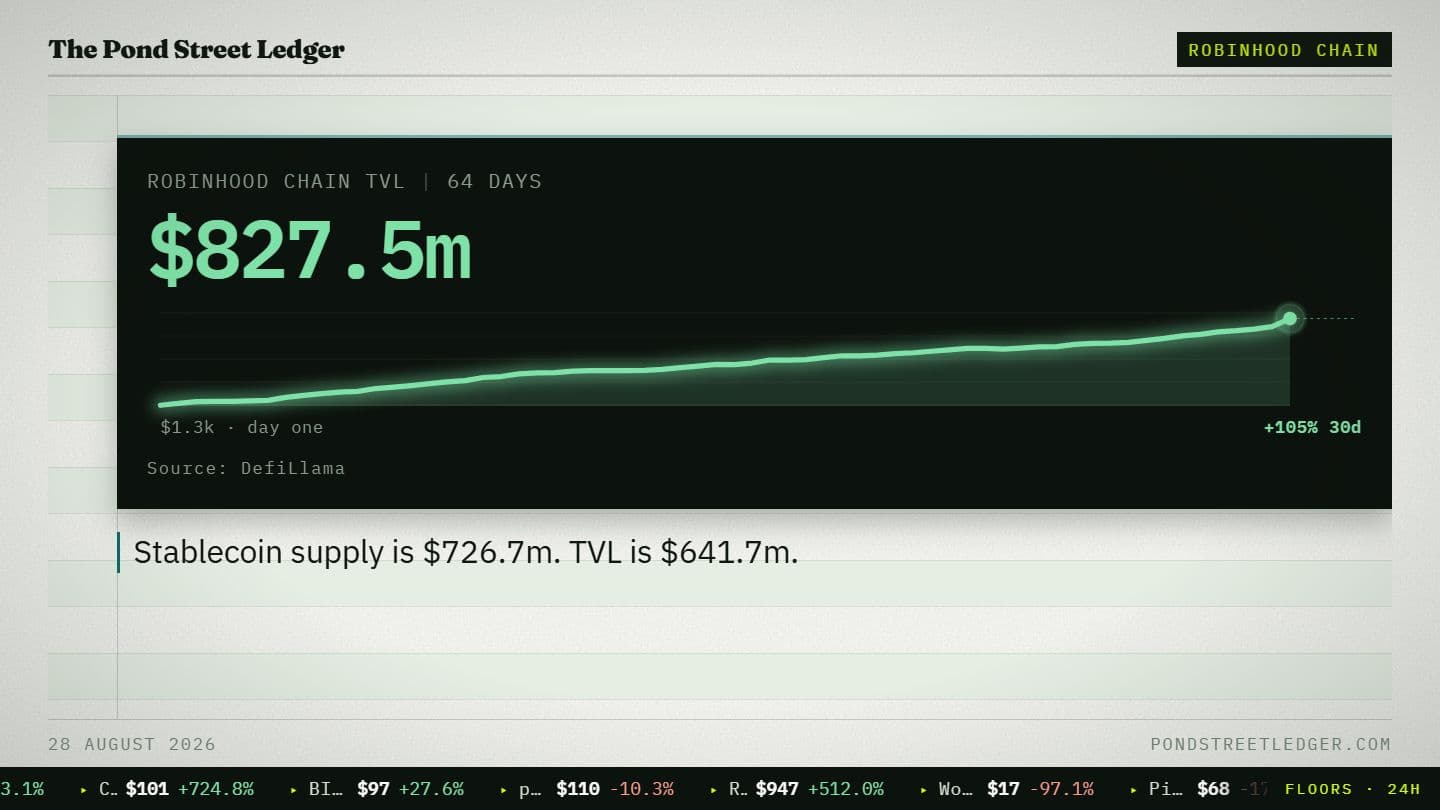
Why a Chain Can Hold More Stablecoins Than Total Value Locked
Robinhood Chain reports $726.7m of stablecoin supply against $641.7m of total value locked. The two numbers count different things, and the gap between them is the most useful thing on the dashboard.
What Happens to Your Token When the Company Splits, Merges or Gets Bought
Dividends are the easy corporate action. Splits, mergers, delistings and tender offers are where tokenized equity wrappers actually get tested, because each one changes what the token is supposed to represent.
What Happens to a Tokenized Stock When the Company Pays a Dividend
Splits, dividends, mergers and ticker changes are routine in equity markets and awkward onchain. Here is the plumbing that decides whether your token still tracks the share it claims to track.
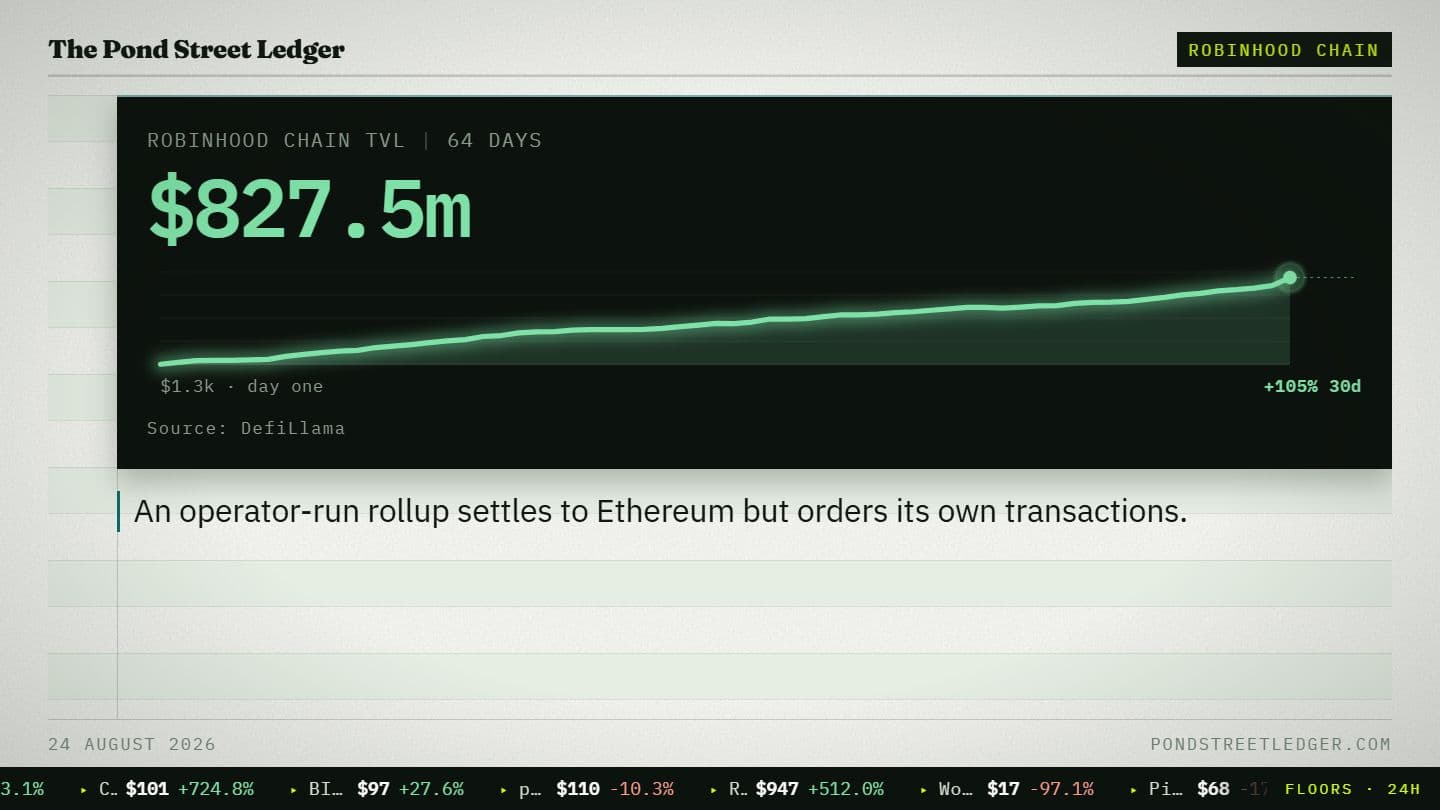
How Robinhood Chain Works, and What a Single Sequencer Means for You
An operator-run rollup settles to Ethereum but orders its own transactions. Here is the machinery, the tradeoffs it buys, and the specific failure modes worth knowing before you leave collateral on it.
What a Tokenized Stock Actually Is, and What You Own When You Hold One
A tokenized stock is almost never the share. It is a claim on someone who holds the share, wrapped in code, and the quality of your position depends entirely on who that someone is.