Custody
Every story this desk has filed under Custody, most recent first.
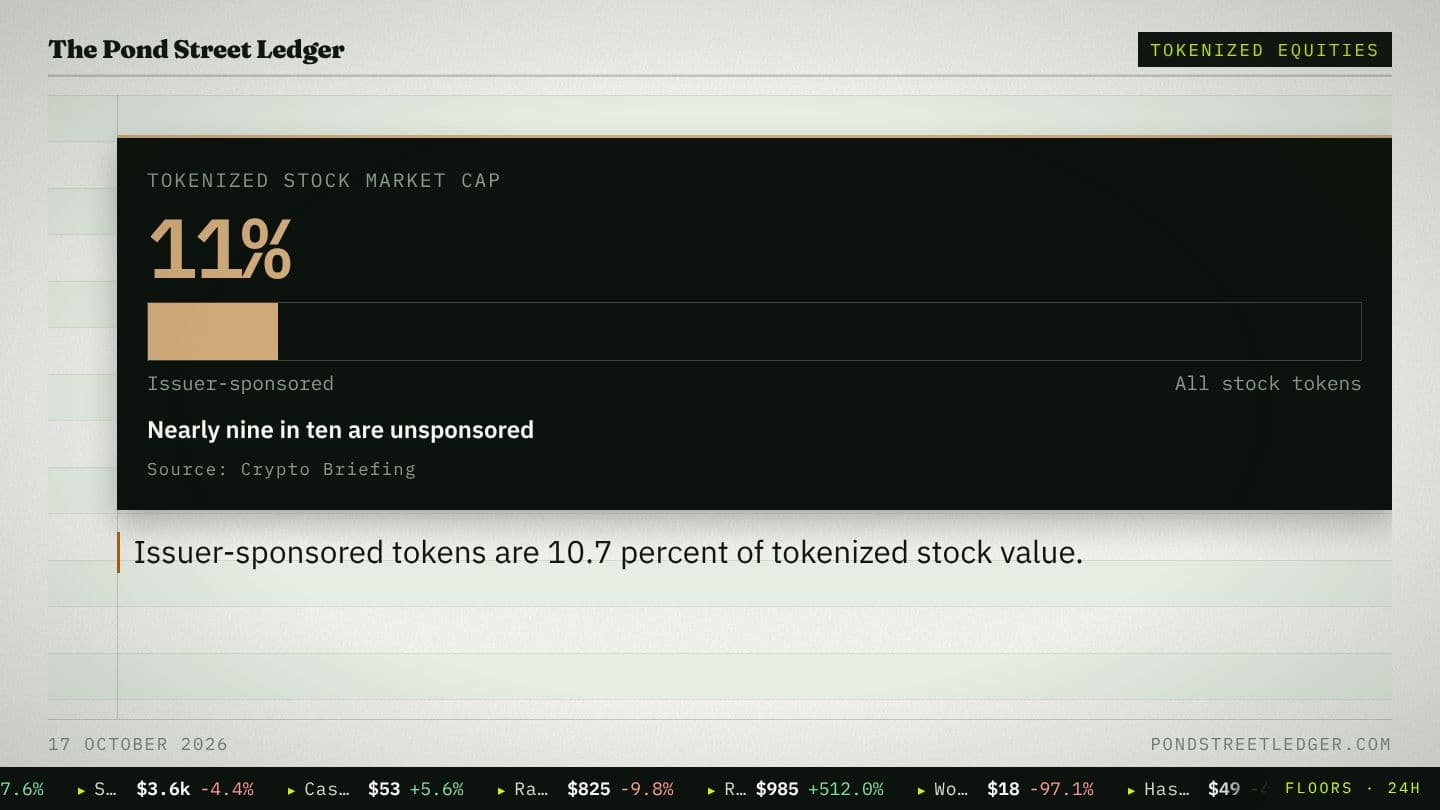
Only a Tenth of Tokenized Stock Value Has the Issuer's Blessing
Just 10.7 percent of tokenized equity market capitalisation comes from issuer-sponsored tokens, Crypto Briefing reports. The rest is synthetic or custodian-backed, and the gap is the whole argument about shareholder rights.
A share pays its holder on a record date fixed by the issuer. A token pays whoever a smart contract says held it, after a custodian has been paid, after tax has been withheld, and usually in something other than the dividend itself.
Redemption is the pipe that connects a token's price to a share price. It is also the pipe most retail holders will never be allowed to use, and understanding why explains most of what a stock token is.
Mergers, delistings, reverse splits and ticker changes all end the life of a share as it was registered. The token tracking it has to be unwound, reissued or frozen, and the rules for that live in the issuer's documents rather than in the contract.
Standard Chartered Adds Singapore to a Custody Network Already Spanning Three Jurisdictions
The bank plans to hold cryptocurrencies, stablecoins and tokenised assets for institutional and accredited corporate clients in Singapore, extending a service it already runs from the UAE, Luxembourg and Hong Kong. No launch date has been given.
Issuers of tokenized equities publish attestations, proof-of-reserve feeds and holdings tables, and each one answers a different question. A guide to reading what is there, and noticing what is not.
Robinhood's $25bn Crypto Pile Is Customer Property, Not a Treasury
Crypto Briefing reports that the roughly $25bn of digital assets sitting at Robinhood is held for brokerage customers, not bought by the company for its own balance sheet. The distinction matters for anyone counting corporate demand.
Every tokenized equity rests on a promise from a legal entity that it holds the share and will hand over the value. This is what that promise is worth in an insolvency, and which structural choices decide it.
The SEC Proposes Letting Investment Advisers Hold Crypto Themselves
A new proposed rule would allow advisers and funds to use state trust companies as custodians and, in some cases, to self-custody digital assets. Comments run 60 days from publication.
A share does things while you hold it. It pays dividends, splits, gets taken over and votes. An explainer on how each of those events is supposed to travel from the share register to a token balance, and the places the signal gets lost.
A tokenized share is a claim that passes through a broker, a custodian, a central securities depository and an issuer before it reaches your wallet. Knowing which link fails first is the whole analysis.
Every tokenized equity claims one-to-one backing. The differences that matter sit in who holds the shares, whose balance sheet they are on, and what the attestation is allowed to say.
Every tokenized equity is a claim that depends on one queue: the redemption window where tokens go back to the issuer and shares or cash come out. Here is how that window works, what closes it, and what your token trades on when it is shut.
Corporate actions are the hardest unglamorous problem in tokenized equities. The share does something, and a token contract has to be told about it in time. Here is the mechanism, and where it fails.
A tokenized stock is two claims stacked on top of each other: a token you control and a share someone else holds for you. Insolvency is the moment those two things get tested against each other.
A tokenized equity is only as good as the chain of custody underneath it. Here is who holds the underlying share, where the token sits in the legal queue, and what each link can do to you.
Secondary trading in tokenized equities is visible on any block explorer. The primary market that mints and burns the tokens is not, and it is the mechanism that decides whether the price on the screen means anything.
A share is not a static object. It pays, it converts, it gets bought out and sometimes it stops existing. Here is how each of those events travels from a company's board resolution to a token in a self-custodied wallet, and where the chain stops being able to help.
The Hardest Problem in Tokenized Equity Is Not Trading, It Is a Stock Split
A tokenized share is easy to move and hard to adjust. Corporate actions, splits, dividends, mergers, spinoffs, force the token to answer for something that happened off the chain, and there is no single accepted way to do it.
Who Actually Holds the Shares Behind a Tokenized Stock, and What They Owe You
Every tokenized equity sits on top of a chain of custody that ends at a real share certificate held by a real institution. Understanding who is holding what, under which legal wrapper, tells you what happens when something goes wrong.
Every issuer says the tokens are fully backed. The question worth asking is what the backing is, who holds it, who checks, and what you can do if the answer turns out to be wrong.
Who Counts as a Holder, and When: The Record Date Problem for Tokenized Stocks
Every dividend, vote and split turns on a snapshot of who owned the share at one instant. Onchain, that instant is a block height, and the two clocks do not agree.
What Settlement Really Means When a Tokenized Stock Changes Hands
The token moves in a block. The share behind it usually does not. This is the gap between onchain finality and the legal transfer of ownership, and who carries the risk while it is open.
What Happens to Your Token When the Company Splits, Merges or Gets Bought
Dividends are the easy corporate action. Splits, mergers, delistings and tender offers are where tokenized equity wrappers actually get tested, because each one changes what the token is supposed to represent.
The SEC's Custody Rewrite Reaches the White House, Which Is Where Rules Go to Be Timed
A proposal to change how investment advisers and funds hold digital assets has been sent for White House review, following the withdrawal of a separate 2023 attempt. Nothing is in force, and the text is not public.
What Happens to a Tokenized Stock When the Company Pays a Dividend
Splits, dividends, mergers and ticker changes are routine in equity markets and awkward onchain. Here is the plumbing that decides whether your token still tracks the share it claims to track.
What a Tokenized Stock Actually Is, and What You Own When You Hold One
A tokenized stock is almost never the share. It is a claim on someone who holds the share, wrapped in code, and the quality of your position depends entirely on who that someone is.